MCQ
The force $7\widehat i + 3\widehat j - 5\widehat k$ acts on a particle whose position vector is $\widehat i - \widehat j + \widehat k$ . What is the  torque of the given force  about the origin ?
  • $2 \widehat i +12\widehat j +10\widehat k$
  • B
    $2\widehat i +10\widehat j +12\widehat k$
  • C
    $2\widehat i +10\widehat j +10\widehat k$
  • D
    $10\widehat i + 2\widehat j + \widehat k$
Answer

Correct option: A.
$2 \widehat i +12\widehat j +10\widehat k$
a
Here, $\vec{r}=\hat{i}-\hat{j}+\hat{k}$

$\overrightarrow{\mathrm{F}}=7 \hat{\mathrm{i}}+3 \hat{\mathrm{j}}-5 \hat{\mathrm{k}}$

Torque, $\vec{\tau}=\vec{r} \times \vec{F}$

$\vec{\tau}=\left|\begin{array}{rrr}{\hat{i}} & {\hat{j}} & {\hat{k}} \\ {1} & {-1} & {1} \\ {7} & {3} & {-5}\end{array}\right|=\hat{i}(5-3)+\hat{j}(7-(-5))+\hat{k}(3-(-7))$

or $\vec{\tau}=2 \hat{\mathrm{i}}+12 \hat{\mathrm{j}}+10 \hat{\mathrm{k}}$

Need a full question paper?

Generate a complete, print-ready paper with questions like this in minutes — across 16+ boards, with answer keys.

Start Generating Free

Similar questions

The energy required to take a satellite to a height $‘h’$ above Earth surface (radius of Earth $= 6.4 \times 10^3\,km$ ) is $E_1$ and kinetic energy required for the satellite to be in a circular orbit at this height is $E_2.$ The value of $h$ for which $E_1$ and $E_2$ are equal is
What should be the angular speed with which the earth have to rotate on its axis so that a person on the equator would weigh $\frac{3}{5}$ th as much as present?
$Assertion$ : An astronaut experience weightlessness in a space satellite.

$Reason$ : When a body falls freely it does not experience gravity

If two liquids of same volume but different densities ${\rho _1}$ and ${\rho _2}$ are mixed, then density of mixture is given by
If the magnitude of sum of two vectors is equal to the magnitude of difference of the two vectors, the angle between these vectors is $........ ^\circ$
The mean life time of a radionuclide, if its activity decrease by $4\%$ for every $1h$ , would be  .......... $h$ [product is non-radioactive i.e. stable]
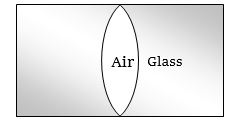
In the figure, an air lens of radii of curvature $10 cm$ (${R_1}$ = ${R_2}$ $= 10 cm$) is cut in a cylinder of glass $(\mu = 1.5)$. The focal length and the nature of the lens is
An ac supply gives $30 V r.m.s.$ which passes through a $10$ $\Omega $ resistance. The power dissipated in it is......$W$
A point like object is placed at a distance of $1\, m$ in front of a convex lens of focal length $0.5\, m .$ A plane mirror is placed at a distance of $2\,m$ behind the lens. The position and nature of the final image formed by the system is 
When ${10^{19}}$ electrons are removed from a neutral metal plate, the electric charge on it is