Question
The force of viscosity is:
- Electromagnetic.
- Gravitational.
- Nuclear.
- Weak.
Explanation:
The force of viscosity arises from molecular Interaction between different layers of fluids that are In motion. Molecular forces are electromagnetic in nature. Therefore, viscosity must also be electromagnetic.
Generate a complete, print-ready paper with questions like this in minutes — across 16+ boards, with answer keys.
The angular momentum of electron in nth orbit is given by
|
(a) nh |
(b) |
(c) n |
(d) |
A point object is placed at a distance of 10 cm and its real image is formed at a distance of 20 cm from a concave mirror. If the object is moved by 0.1 cm towards the mirror, the image will shift by about
|
(a) 0.4 cm away from the mirror |
(b) 0.4 cm towards the mirror |
|
(c) 0.8 cm away from the mirror |
(d) 0.8 cm towards the mirror |
Dielectric constant for metal is
|
(a) Zero |
(b) Infinite |
(c) 1 |
(d) Greater than 1 |
Source of Sun's energy is
|
(a) Burning of hydrogen |
(b) Fission reactions involving hydrogen |
|
(c) Fusion reactions involving hydrogen |
(d) Some other source |
Which of the following are not electromagnetic waves
|
(a) Cosmic rays |
(b) Gamma rays |
(c) b-rays |
(d) X-rays |
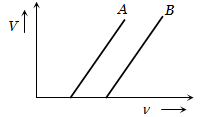
The stopping potential as a function of the frequency of the incident radiation is plotted for two different photoelectric surfaces A and B. The graphs show that work function of A is
|
(a) Greater than that of B |
|
(b) Smaller than that of B |
|
(c) Equal to that of B |
|
(d) No inference can be drawn about their work functions from the given graphs |
A thin oil layer floats on water. A ray of light making an angle of incidence of 40° shines on oil layer. The angle of refraction of light ray in water is ( )
)
|
(a) 36 .1° |
(b) 44.5° |
(c) 26. 8° |
(d) 28.9° |
The electric potential at the surface of an atomic nucleus (Z = 50) of radius 9.0 ×  cm is
cm is
|
(a) 80 volts |
(b) 8 |
(c) 9 volts |
(d) 9 |


