MCQ
The frequency and intensity of a light source are both doubled. Consider the following statements.
  1. The saturation photocurrent remains almost the same.
  2. The maximum kinetic energy of the photoelectrons is doubled.
  • A
    Both $A$ and $B$ are true.
  • $A$ is true but $B$ is false.
  • C
    $A$ is false but $B$ is true.
  • D
    Both $A$ and $B$ are false.

Answer

Correct option: B.
$A$ is true but $B$ is false.

Saturated current varies directly with the intensity of light. As the intensity of light is increased, a large number of photons fall on the metal surface. As a result, a large number of electrons interact with the photons. As a result, the number of emitted electrons increases and, hence, the current also increases.
At the same time, the frequency of the light source also increases.Also, with the increase in frequency of light, the stopping potential increases as well. This will reduce the current. The combined effect of these two is that the current will remain the same. Hence, $A$ is true.
From the Einstein's photoelectric equation.
$\text{K}_\text{max}= \text{hv}-\varphi$
Where $K_{max} =$ kinetic energy of electron
$v =$ frequency of light
$\varphi =$ work function of metal
It is clear from the above equation. As the frequency of light source is doubled, kinetic energy of electron increases. But, it becomes more than the double.
Need a full question paper?

Generate a complete, print-ready paper with questions like this in minutes — across 16+ boards, with answer keys.

Start Generating Free

Similar questions

If a voltage applied to an $X$ - ray tube is increased to $1.5$ times the minimum wavelength $({\lambda _{\min }})$ of an $X$ - ray continuous spectrum shifts by $\Delta \lambda = 26\,pm$. The initial voltage applied to the tube is
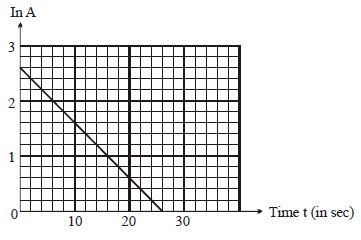
The graph in figure shows how the count-rate $A$ of a radioactive source as measured by a Geiger counter varies with time $t.$ The relationship between $A$ and $t$ is : $($ Assume $ln\,\, 12 = 2.6)$
An unknown hot gas emits radiation of wavelengths $46.0\ nm, 82.8\ nm$ and $103.5\ nm $ only. Assume that the atoms have only two excited states and the difference between consecutive energy levels decreases as energy is increased. Taking the energy of the highest energy state to be zero, find the energies of the ground state and the first excited state.
In a cathode ray tube, what is the effect on the beam of particles if a hotter filament is used?
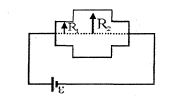
A cylindrical resistance is connected across battery $\varepsilon $ . Cylinder has uniform free electron density, mid part of cylinder has larger radius as shown in figure. Then $V_d$  (drift velocity) $V/S$ (distance across the length of the resistance)
A charge $+ Q$ is moving upwards vertically. It enters a magnetic field directed to the north. The force on the charge will be towards
In Young's double slit experiment, the distance between the slits is $1 \,mm$ and that between slit and screen is $1 $ meter and $10th $ fringe is $5 \,mm$ away from the central bright fringe, then wavelength of light used will be.....$\mathop A\limits^o $
In a semiconductor, the concentration of electrons is $8 \times 10^{12} cm^3$ and that of the holes is $5 \times 10^{12} cm^3$. The semiconductor is
A stream of electrons is projected horizontally to the right. A straight conductor carrying a current is supported parallel to the electron stream and above it. If the current in the conductor is from left to right, what will be the effect on the electron stream?
If the strength of the magnetic field produced $10\,cm$ away from a infinitely long straight conductor is ${10^{ - 5}}\,Weber/{m^2}$, the value of the current flowing in the conductor will be........$ampere$