- AContinuous at $x = 1$
- BContinuous at $x = 3$
- CDifferentiable at $x = 1$
- ✓All the above
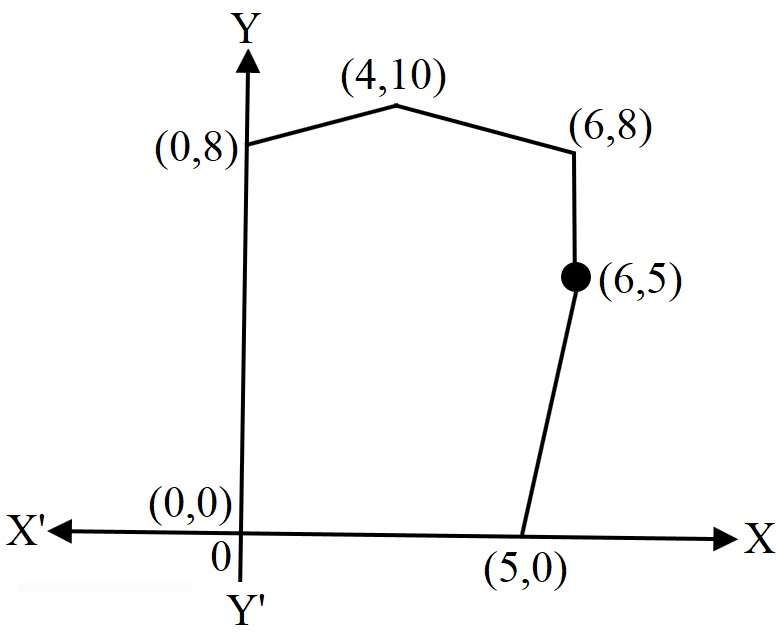
$\therefore $ The given function can be defined as
$f(x) = \left\{ {\begin{array}{*{20}{r}}{\frac{1}{4}{x^2} - \frac{3}{2}x + \frac{{13}}{4},}&{x < 1\,\,\,\,\,\,\,\,}\\{3 - x,}&{1 \le x < 3}\\{x - 3,}&{x \ge 3\,\,\,\,\,\,\,}\end{array}} \right.$
Now proceed to check the continuity and differentiability at $x = 1.$
Generate a complete, print-ready paper with questions like this in minutes — across 16+ boards, with answer keys.
$L _1: \overrightarrow{ r }=\lambda \hat{ i }, \lambda \in R ,$
$L _2: \overrightarrow{ r }=\hat{ k }+\mu \hat{ j }, \mu \in R \text { and }$
$L _3: \overrightarrow{ r }=\hat{ i }+\hat{ j }+ vk , v \in R$
are given. For which point(s) $Q$ on $L_2$ can we find a point $P$ on $L_1$ and a point $R$ on $L_3$ so that $P$, $Q$ and $R$ are collinear?
$(1)$ $\hat{k}+\hat{j}$ $(2)$ $\hat{ k }$ $(3)$ $\hat{ k }+\frac{1}{2} \hat{ j }$ $(4)$ $\hat{k}-\frac{1}{2} \hat{j}$
