MCQ
The function $f:[0,3] \rightarrow[1,29]$, defined by $f(x)=2 x^3-15 x^2+36 x+1$, is
- Aone-one and onto
- ✓onto but not one-one
- Cone-one but not onto
- Dneither one-one nor onto
$f(x)=2 x^3-15 x^2+36 x+1 $
$f^{\prime}(x)=6 x^2-30 x+36 $
$=6\left(x^2-5 x+6\right) $
$=6(x-2)(x-3)$
in given domain function has local maxima, it is many-one
Now at
$x=0 $$ f(0) $$ =1 $
$x=2 $$ f(2) $$ =16-60+72+1=29 $
$x $$ =3 $$ f(3) $$ =54-135+108+1 $
$ =163-135=28$
Has range $=[1,29]$
Hence given function is onto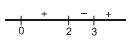
Generate a complete, print-ready paper with questions like this in minutes — across 16+ boards, with answer keys.
$f_n(x)=\sum_{j=1}^n \tan ^{-1}\left(\frac{1}{1+(x+j)(x+j-1)}\right) \text { for all } x \in(0, \infty)$
(Here, the inverse trigonometric function $\tan ^{-1} x$ assumes values in $\left(-\frac{\pi}{2}, \frac{\pi}{2}\right)$ )
Then, which of the following statement(s) is (are) TRUE?
$(A)$ $\sum_{ j =1}^5 \tan ^2\left( f _{ j }(0)\right)=55$
$(B)$ $\sum_{ j =1}^{10}\left(1+ f _{ j }^{\prime}(0)\right) \sec ^2\left( f _{ j }(0)\right)=10$
$(C)$ For any fixed positive integer $n$, $\lim _{x \rightarrow \infty} \tan \left(f_n(x)\right)=\frac{1}{n}$
$(D)$ For any fixed positive integer $n, \lim _{x \rightarrow \infty} \sec ^2\left(f_n(x)\right)=1$