Question
The function $f(x) = 2x^3 - 3x^2 - 12x + 4,$ has:

Answer

We have, $f(x) = 2x^3 - 3x^2 - 12x + 4$
$\Rightarrow f'(x) = 6x^2 - 6x - 12$
$\Rightarrow f'(x) = 6(x^2 - x - 2)$
$\Rightarrow f'(x) = 6(x + 1)(x - 2)$
Find the critical points by equating $f'(x)$ to $0.$
$\therefore f'(x) = 0$
$\Rightarrow 6(x + 1)(x - 2) = 0$
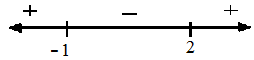
$\Rightarrow x = -1$ and $x = +2$​​​​​​​

From the above number line, we can conclude that, $x = -1$ is point of local maxima and $x = 2$ is point of local minima.
Thus, $f(x)$ has one maxima and one minima.

Need a full question paper?

Generate a complete, print-ready paper with questions like this in minutes — across 16+ boards, with answer keys.

Start Generating Free

Similar questions

If $\text{A}=\begin{vmatrix} 1 &\text{amp; 2} \\ 2 &\text{amp; 1} \end{vmatrix}$ and $\text{f}\text{(x)}=\frac{1+\text{x}}{1-\text{x}},$  then $\text{f}(|\text{A}|)$ is:
  1. $\dfrac{-1}{2}$
  2. $\dfrac{1}{2}$
  3. $\dfrac{-1}{3}$
  4. $\text{None of these}$
If $A$ is a square matrix of order $3$ such that the value of $|\operatorname{adj} A|=8,$ then the value of $\left|A^{\top}\right|$ is
What is the order of differential equation y’’ + 5y’ + 6 = 0?
  1. 0
  2. 1
  3. 2
  4. 3
Which of the following statements is correct?
The function $\text{f(x)}=\sin^{-1}(\cos\text{x})$ is:
  1. Discontinuous at x = 0
  2. Continuous at x = 0
  3. Differentiable at x = 0
  4. None of these.
At $\text{x}=\frac{5\pi}{6},\text{ f(x)}=2\sin3\text{x}+3\cos\text{x}$ is 6:
If $\text{x}=\text{at}^2,\text{y}=2\text{at}$ then $\frac{\text{d}^2\text{y}}{\text{dx}^2}$=
  1. $-\frac{1}{\text{t}^2}$
  2. $\frac{1}{2\text{at}^3}$
  3. $-\frac{1}{\text{t}^3}$
  4. $-\frac{1}{2\text{at}^3}$
ox, oy are positive x-axis, positive y-axis respectively where O = (0, 0,0)  The d.c.s of the llne which bisects $\angle\text{xoy}$ are:
If $A=\left[\begin{array}{rr}\cos \alpha & -\sin \alpha \\ \sin \alpha & \cos \alpha\end{array}\right]$, then for what value of $\alpha, A$ is an identity matrix?
The vector equation of the plane containing the line $\vec{\text{r}}=(-2\hat{\text{i}}-3\hat{\text{j}}+\hat{\text{k}})+\lambda(3\hat{\text{i}}-2\hat{\text{j}}-\hat{\text{k}})$ and the point $\hat{\text{i}}+2\hat{\text{j}}+3\hat{\text{k}}$ is:
  1. $\vec{\text{r}}.(\hat{\text{i}}+3\hat{\text{k}})=10$
  2. $\vec{\text{r}}.(\hat{\text{i}}-3\hat{\text{k}})=10$
  3. $\vec{\text{r}}.(3\hat{\text{i}}+\hat{\text{k}})=10$
  4. $\text{None of these}$