MCQ
The function f(x) = 2x3 - 3x2 - 12x + 4, has:
  • A
    Two points of local maximum.
  • B
    Two points of local minimum.
  • C
    One maxima and one minima.
  • D
    No maxima or minima.

Answer

  1. One maxima and one minima.

Solution:

We have, f(x) = 2x3 - 3x2 - 12x + 4

⇒ f'(x) = 6x2 - 6x - 12

⇒ f'(x) = 6(x2 - x - 2)

⇒ f'(x) = 6(x + 1)(x - 2)

Find the critical points by equating f'(x) to 0.

$\therefore$ f'(x) = 0

⇒ 6(x + 1)(x - 2) = 0

⇒ x = -1 and x = +2
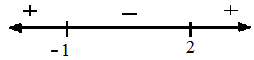
From the above number line, we can conclude that, x = -1 is point of local maxima and x = 2 is point of local minima.

Thus, f(x) has one maxima and one minima.

Need a full question paper?

Generate a complete, print-ready paper with questions like this in minutes — across 16+ boards, with answer keys.

Start Generating Free

Similar questions

Let  ${\tan ^{ - 1}}\left( {\tan \frac{{5\pi }}{4}} \right) = \alpha ,{\tan ^{ - 1}}\left( { - \tan \frac{{2\pi }}{3}} \right) = \beta $ Then :-
A vector of length $3$  perpendicular to each of the vectors $3\,i + j - 4\,k$ and $6\,i + 5\,j - 2\,k$ is
Let $[ t ]$ denote the greatest integer less than or equal to $t$. Then the value of $\int \limits_{1}^{2}|2 x-[3 x]| d x$ is
$\int_{}^{} {\frac{{dx}}{{\sin x + \cos x}}} = $
If the function $y = e^{4x} + 2e^{-x}$ is a solution of the differential equation $\frac{{\frac{{{d^3}y}}{{d{x^3}}} - 13\frac{{dy}}{{dx}}}}{y} = K$ then the value of $K$ is
The Solution of $\cos(\text{x}+\text{y})\text{ dy}=\text{dx}$ is:
  1. $\text{y}=\tan\Big(\frac{\text{x}+\text{y}}{2}\Big)+\text{c}$
  2. $\text{y}=\cos^{-1}\Big(\frac{\text{y}}{\text{x}}\Big)+\text{c}$
  3. $\text{y}=\text{x}\sec\Big(\frac{\text{y}}{\text{x}}\Big)+\text{c}$
  4. $\text{None of these}$
The value of the definite integral $\int\limits_0^{\frac{1}{{\sqrt 2 }}} {\frac{{{x^2}dx}}{{\sqrt {1 - {x^2}} \,(1 + \sqrt {1 - {x^2}} )}}} $ is
The area of the plane region bounded by the curves x + 2y2 = 0 and x + 3y2 = 1is equal to:
  1. $\frac{5}{3}$
  2. $\frac{1}{3}$
  3. $\frac{2}{3}$
  4. $\frac{4}{3}$
Let the solution curve $y=f(x)$ of the differential equation $\frac{d y}{d x}+\frac{x y}{x^{2}-1}=\frac{x^{4}+2 x}{\sqrt{1-x^{2}}}, x \in(-1,1)$ pass through the origin. Then $\int_{-\frac{\sqrt{3}}{2}}^{\frac{\sqrt{3}}{2}} f ( x ) dx$ is equal to 
$\left| {\,\begin{array}{*{20}{c}}{{a^2} + {x^2}}&{ab}&{ca}\\{ab}&{{b^2} + {x^2}}&{bc}\\{ca}&{bc}&{{c^2} + {x^2}}\end{array}\,} \right|$ is divisor of