MCQ
The function $F(x) = \int_0^x {\log \left( {\frac{{1 - x}}{{1 + x}}} \right)} \,dx$ is
  • An even function
  • B
    An odd function
  • C
    A periodic function
  • D
    None of these

Answer

Correct option: A.
An even function
a
(a) We know that if  $f(t)$ is an odd function, then $\int_0^x {f(t)} $ $dt$ is an even function. 

since the function here $f(x) = \log \frac{{1 - x}}{{1 + x}}$ is an odd function, 

therefore $F(x)$ is an even function.

Need a full question paper?

Generate a complete, print-ready paper with questions like this in minutes — across 16+ boards, with answer keys.

Start Generating Free

Similar questions

Evaluate : $\sin \left[\frac{\pi}{3}+\sin ^{-1}\left(\frac{1}{2}\right)\right]$
The values of $a,$ for which points $A, B, C$ with position $2i-j+k ,i-3j-5k $ and $ ai-3j+k$ respectively are  the vertices of a right angled triangle with $m\angle C = 90^\circ $ are
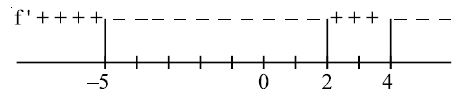
 $(i)$  $f (x)$ is continuous and defined for all real numbers

$(ii)$ $f '(-5) = 0 \,; \,f '(2)$ is not defined and $f '(4)  = 0$

$(iii)$ $(-5, 12)$ is a point which lies on the graph of $f (x)$

$(iv)$ $f ''(2)$ is undefined, but $f ''(x)$ is negative everywhere else.

$(v)$ the signs of  $f '(x)$ is given below

On the possible graph of $y = f (x)$ we have  
The area of the region bounded by the curve $\text{y}=\sqrt{16-\text{x}^2}$ and $x-$ axis is :
Let $I = \int_a^b {\left( {{x^4} - 2{x^2}} \right)dx} $. If $I$ is minimum then the ordered pair $(a, b)$ is
If $(\text{x}+2\text{y}^3)\frac{\text{dy}}{\text{dx}}=\text{y},$ then:
The value of $ \cos { \left( \tan ^{ -1 }{ \tan { 4 } } \right) }$ is-
The radius of the base of a cone is increasing at the rate of $3\ cm/$ minute and the altitude is decreasing at the rate of $4\ cm/$ minute. The rate of change of lateral surface when the radius $= 7\ cm$ and altitude $24\ cm$ is :
Let function $F$ be defined as $f\left( x \right) = \int\limits_1^x {\frac{{{e^t}}}{t}dt\,,\,x > 0} $ then the value of the integral $\int\limits_1^x {\frac{{{e^t}}}{{t + a}}dt\,} $ , where $a > 0$ , is
The differential equation $\frac{\text{dx}}{\text{dx}}=\frac{1}{\text{ax}+\text{by}+\text{c}},$ where $a, b, c$ are all non zero real numbers, is: