MCQ
The function $f(x) = x − [x],$ where $[⋅]$ denotes the greatest integer function is :
  • A
    Continuous everywhere.
  • B
    Continuous at integer points only.
  • Continuous at non $-$ integer points only.
  • D
    Differentiable everywhere.

Answer

Correct option: C.
Continuous at non $-$ integer points only.
$f(x) = x - x$
Consider $n$ be an integer.
$\text{f(x)}=\text{x}-[\text{x}]=\begin{cases}\text{x}-(\text{n}-1)&\text{n}-1\leq\text{x}<\text{n}\\0&\text{x}=\text{n}\\\text{x}-\text{n}&\text{n}\leq\text{x}<\text{n}+1\end{cases}$
Now,
$\text{LHL}$ at $x = n$
$=\lim\limits_{\text{x}\rightarrow\text{n}^{-}}\text{f(x)}=\text{x}-\text{n}-1=\text{x}-\text{n}+1$
RHL at x = n
$=\lim\limits_{\text{x}\rightarrow\text{n}^{+}}\text{f(x)}=\text{x}-\text{n}=\text{x}-\text{n}$ As,
$\text{LHL}\neq\text{RHL}$ at $x = n$
i.e., given function is not continuous at $n.$
Now, $n$ is any integer.
Therefore, given function is not continuous at integers.
Therefore, given points are continuous at non $-$ integer points only.

Need a full question paper?

Generate a complete, print-ready paper with questions like this in minutes — across 16+ boards, with answer keys.

Start Generating Free

Similar questions

If $A = \left[ {\begin{array}{*{20}{c}}
{\cos \,\theta }&{ - \sin \,\theta }\\
{\sin \,\theta }&{\cos \,\theta }
\end{array}} \right]$, then the matrix ${A^{ - 50}}$ when $\theta  = \frac{\pi }{{12}}$ is equal to 
$\int_{}^{} {\frac{{dx}}{{x[{{(\log x)}^2} + 4\log x - 1]}}} = $
Find the order of differential equations$:\ 2\text{x}^2\frac{\text{d}^2\text{y}}{\text{d}\text{y}^2}-3\frac{\text{dx}}{\text{dx}}+\text{y}=0$
 $(i)$  $f (x)$ is continuous and defined for all real numbers

$(ii)$ $f '(-5) = 0 \,; \,f '(2)$ is not defined and $f '(4)  = 0$

$(iii)$ $(-5, 12)$ is a point which lies on the graph of $f (x)$

$(iv)$ $f ''(2)$ is undefined, but $f ''(x)$ is negative everywhere else.

$(v)$ the signs of  $f '(x)$ is given below

Possible graph of $y = f (x)$ is
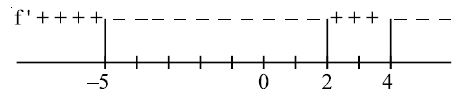
If $A$ is nilpotent matrix of index $2$, then $A(I_2+A)^{51}$ is equal to (where $I_2$ is the identity matrix of order $2$)
Let $f ( x )=\frac{ x }{\left(1+ x ^{ n }\right)^{\frac{1}{ n }}}, x \in R -\{-1\}, n \in N , n > 2$. If $f ^{ n }( x )= (fofof \ldots \ldots$ upto $n$ times) $( x )$, then $\operatorname{Lim}_{n \rightarrow \infty} \int \limits_0^1 x^{n-2}\left(f^n(x)\right) d x$ is equal to $...............$.
Let $f(x) = sin\ x, g(x) = cos\ x$ , then which of the following statement is false
The direction cosines of the line joining the points $(4, 3, -5)$ and $(-2, 1, -8)$ are
Let $I_{n}(x)=\int_{0}^{x} \frac{1}{\left(t^{2}+5\right)^{n}} d t, n=1,2,3, \ldots .$ Then
If $A\, = \,\left[ {\begin{array}{*{20}{c}}
1&2&x\\
3&{ - 1}&2
\end{array}} \right]$ and $B\, = \,\left[ {\begin{array}{*{20}{c}}
y\\
x\\
1
\end{array}} \right]$ be such that $AB\, = \,\left[ {\begin{array}{*{20}{c}}
6\\
8
\end{array}} \right],$ then