MCQ
The function $f(x)=2 x+3(x)^{\frac{2}{3}}, x \in \mathbb{R}$, has
  • A
     exactly one point of local minima and no point of local maxima
  • B
    exactly one point of local maxima and no point of local minima
  •  exactly one point of local maxima and exactly one point of local minima
  • D
     exactly two points of local maxima and exactly one point of local minima

Answer

Correct option: C.
 exactly one point of local maxima and exactly one point of local minima
c
$ f(x)=2 x+3(x)^{\frac{2}{3}} $

$ f^{\prime}(x)=2+2 x^{\frac{-1}{3}} $

$ =2\left(1+\frac{1}{x^{\frac{1}{3}}}\right) $

$ =2\left(\frac{x^{\frac{1}{3}}+1}{x^{\frac{1}{3}}}\right) $

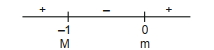
$ +\frac{1}{+}-\mathrm{m}^{-1}$

So, $\operatorname{maxima}(\mathrm{M})$ at $\mathrm{x}=-1$ $\operatorname{minima}(\mathrm{m})$ at $\mathrm{x}=0$

Need a full question paper?

Generate a complete, print-ready paper with questions like this in minutes — across 16+ boards, with answer keys.

Start Generating Free

Similar questions

For non-singular square matrix A, B and C of the same order (AB-1 C) =
  1. A-1 BC-1
  2. C-1 B-1 A-1
  3. CBA-1
  4. C-1 BA-1
The maximum value of $12\,\,  sin\theta\,\, -\,\,  9\,\,  sin^2\theta$ is
If the projection of the vector $\hat{\mathrm{i}}+2 \hat{\mathrm{j}}+\hat{\mathrm{k}}$ on the sum of the two vectors $2 \hat{\mathrm{i}}+4 \hat{\mathrm{j}}-5 \hat{\mathrm{k}}$ and $-\lambda \hat{i}+2 \hat{j}+3 \hat{k}$ is $1,$ then $\lambda$ is equal to ..... .
If O and O' are circumcenter and orthocenter of $\triangle{\text{ABC}}$ , then $\overrightarrow{\text{OA}}+\overrightarrow{\text{OB}}+\overrightarrow{\text{OC}}$ equals,
  1. $2\overrightarrow{\text{OO}'}$
  2. $\overrightarrow{\text{OO}'}$
  3. $\overrightarrow{\text{O}'\text{O}}$
  4. $2\overrightarrow{\text{O}'\text{O}}$
$\int_0^{\pi /4} {{{\tan }^2}x\,dx = } $
A fair die is thrown until $2$ appears. Then the probability, that $2$ appears in even number of throws, is
The area of the region bounded by the parabola y = x2 + 1 and the straight line x + y = 3 is given by:
  1. $\frac{45}{7}\text{sq.}\text{units}$
  2. $\frac{25}{4}\text{sq.}\text{units}$
  3. $\frac{5}{18}\text{sq.}\text{units}$
  4. $\frac{9}{2}\text{sq.}\text{units}$
The sum of the absolute minimum and the absolute maximum values of the function $f(x)=\left|3 x-x^{2}+2\right|-x$ in the interval $[-1,2]$ is
If from Lagrange's mean value theorem, we have
$\text{f}'(\text{x}_1)=\frac{\text{f}(\text{b})-\text{f}(\text{a})}{\text{b}-\text{a}},$ then:
  1. $\text{a}<\text{x}_1\leq\text{b}$
  2. $\text{a}\leq\text{x}_1<\text{b}$
  3. $\text{a}<\text{x}_1<\text{b}$
  4. $\text{a}\leq\text{x}_1\leq\text{b}$
If  $A$  and $ B $ are non-singular matrices, then