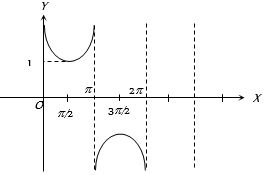
MCQ
The function which is neither decreasing nor increasing in $\left( {{\pi \over 2},{{3\pi } \over 2}} \right)$ is
  • $cosec\, x$
  • B
    $\tan x$
  • C
    ${x^2}$
  • D
    $|x - 1|$

Answer

Correct option: A.
$cosec\, x$
a
(a) The graph of cosec $ x$  is opposite in $\left( {\frac{\pi }{2},\,\,\frac{{3\pi }}{2}} \right)$.

Need a full question paper?

Generate a complete, print-ready paper with questions like this in minutes — across 16+ boards, with answer keys.

Start Generating Free

Similar questions

Choose the correct answer from the given four options.
The reflection of the point $(\alpha,\beta,\gamma)$ in the xy–plane is:
The derivative of the function, $f(x)=cos^{-1} \left\{ \,\frac{1}{{\sqrt {13} }}(2\cos x - 3\sin x)\,\,\,\right\}$

$ + sin^{-1} \left\{ \,\frac{1}{{\sqrt {13} }}(2\cos x + 3\sin x)\,\,\,\right\} $ w.r.t. at $x = \frac{3}{4}$ is :

The lines $\frac{\text{x}}{1}=\frac{\text{y}}{2}=\frac{\text{z}}{3}$ and $\frac{\text{x}-1}{-2}=\frac{\text{y}-2}{-4}=\frac{\text{z}-3}{-6}$ are:
  1. Coinicident.
  2. Skew.
  3. Intersecting.
  4. Parallel.
On the interval $\left( {0,{\pi \over 2}} \right)$, the function $ log \,sin \,x $ is
Two events A and B will be independent, if

  1. A and B are mutually exclusive

  2. $\text{P}(\text{A}'\text{B}')=\big[1-\text{P}(\text{A})\big]\big[1-\text{P}(\text{B})\big]$

  3. P(A) = P(B)

  4. P(A) + P(B) = 1

The area bounded by the curve y = f(x), the x-axis and x = 1 and x = b is (b – 1) sin (3b + 4). Then, f(x) is:
  1. $(\text{x}-1)\cos(3\text{x}+4)$
  2. $\cos(3\text{x}+4)$
  3. $\sin(\text{3x}-4)+3(\text{x}-1).\cos(3\text{x}+4)$
  4. $\text{none}\text{ of}\text{ these}$
Choose the correct answer from the given four option.
The degree of the differential equation $\Big(\frac{\text{d}^2\text{y}}{\text{d}\text{x}^2}\Big)+\Big(\frac{\text{d}\text{y}}{\text{d}\text{x}}\Big)^2-\sin\Big(\frac{\text{d}\text{y}}{\text{d}\text{x}}\Big)$ is:
  1. 1
  2. 2
  3. 3
  4. Not defined
The differential equation ${\left( {\frac{{{d^2}y}}{{d{x^2}}}} \right)^2} - {\left( {\frac{{dy}}{{dx}}} \right)^{1/2}} = {y^3}$ has the degree
 Let $y=y(x)$ be the solution curve of the differential equation $\frac{d y}{d x}=\frac{y}{x}\left(1+x y^2\left(1+\log _e x\right)\right)$ $x > 0, y(1)=3$. Then $\frac{y^2(x)}{9}$ is equal to :
The distance of point (1, 2, 3) from origin is