Question
The function$\text{f(x)}=1+|\cos\text{x}|$ is:
  1. Continuous no where.
  2. Continuous everywhere.
  3. Not differentiable at x = 0
  4. Not differentiable at $\text{x}=\text{n}\pi,\text{n}\in\text{Z}.$
Answer

  1. Continuous everywhere.
Solution:
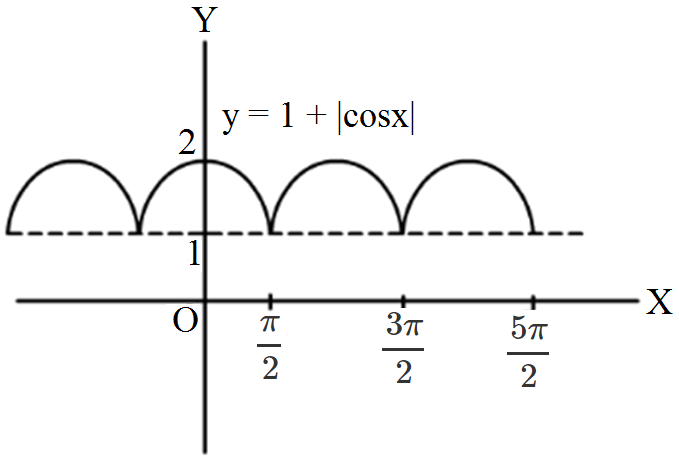
Graph of the function $\text{f(x)}=1+|\cos\text{x}|$ is as show blow:

From the graph, we can see that f(x) is everywhere continuous but not differentiable at $\text{x}=(2\text{n}+1)\frac{\pi}{2},\text{n}\in\text{Z}.$

Need a full question paper?

Generate a complete, print-ready paper with questions like this in minutes — across 16+ boards, with answer keys.

Start Generating Free

Similar questions

Choose the correct answer from given four options in each of the Exercise:
The number of distinct real roots of $\begin{vmatrix}\sin\text{x}&\cos\text{x}&\cos\text{x}\\\cos\text{x}&\sin\text{x}&\cos\text{x}\\\cos\text{x}&\cos\text{x}&\sin\text{x}\end{vmatrix}=0$ in the interval $-\frac{\pi}{4}\leq\text{x}\leq\frac{\pi}{4}$ is$:$
If $\text{A}=\begin{bmatrix} \text{a} & 0 & 0 \\ 0 & \text{a} & 0 \\ 0 & 0 &\text{a} \end{bmatrix},$ then the value of $|$adj $A|$ is$:$
The angle of intersection of the parabolas $y^2 = 4 ax$ and $x^2 = 4ay$ at the origin is:
Let $X=\{0,1,2,3\}$ and $Y=\{-1,0,1,4,9\}$ and a function $f: X \rightarrow Y$ defined by $y=x^2$, is
The value of $k(k<0)$ for which the function $f$ defined as $f(x)=\left\{\begin{array}{cc}\frac{1-\cos k x}{x \sin x} & , x \neq 0 \\ \frac{1}{2} & , x=0\end{array}\right.$ is continuous at $x=0$ is
If a line makes angles $\frac{\pi}{2}, \frac{3 \pi}{4}$ and $\frac{\pi}{4}$ with $X, Y$, and $Z$-axes respectively, then its direction cosines are
Choose the correct answer
If $\theta$ is the angle between any two vectors $\vec{\text{a}}\ \text{and}\ \vec{\text{b}}, \text{then}\ |\vec{\text{a}}\cdot\vec{\text{b}}|=|\vec{\text{a}}\times\vec{\text{b}}|\ \text{when}\ \theta$ is equal to
  1. 0
  2. $\frac{\pi}{4}$
  3. $\frac{\pi}{2}$
  4. $\pi$
The domain of the function $\cos ^{-1}(2 x-1)$ is
Choose the correct answer from the given four options. Assume that in a family, each child is equally likely to be a boy or a girl. A family with three children is chosen at random. The probability that the eldest child is a girl given that the family has at least one girl is:
The corner points of the bounded feasible region determined by a system of linear constraints are $(0,3),(1,1)$ and $(3,0)$. Let $Z=p x+q y$, where $p, q>0$,. The condition on $p$ and $q$ so that the minimum of $Z$ occurs at $(3,0)$ and $(1,1)$ is