Question
The function$\text{f(x)}=1+|\cos\text{x}|$ is:
  1. Continuous no where.
  2. Continuous everywhere.
  3. Not differentiable at x = 0
  4. Not differentiable at $\text{x}=\text{n}\pi,\text{n}\in\text{Z}.$
Answer

  1. Continuous everywhere.

Solution:

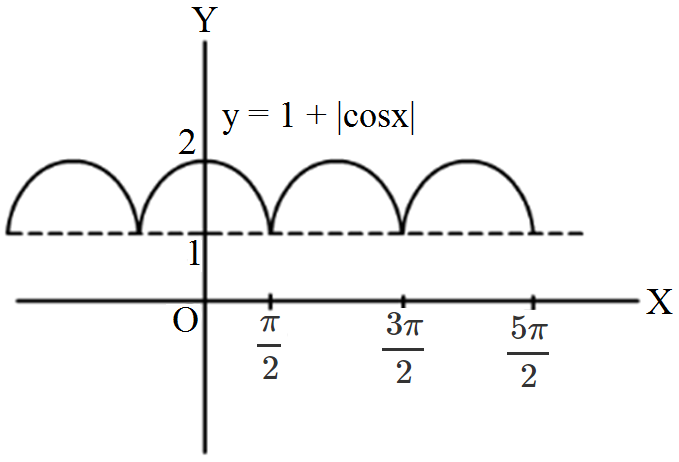
Graph of the function $\text{f(x)}=1+|\cos\text{x}|$ is as show blow:

From the graph, we can see that f(x) is everywhere continuous but not differentiable at $\text{x}=(2\text{n}+1)\frac{\pi}{2},\text{n}\in\text{Z}.$

Need a full question paper?

Generate a complete, print-ready paper with questions like this in minutes — across 16+ boards, with answer keys.

Start Generating Free

Similar questions

Choose the correct answer from the given four options.
In a college, 30% students fail in physics, 25% fail in mathematics and 10% fail in both. One student is chosen at random. The probability that she fails in physics if she has failed in mathematics is:
The direction cosines l, m and n of two lines are connected by the relations l + m + n = 0, l m = 0, then the angles between them is:
  1. $\frac{\pi}{3}$
  2. $\frac{\pi}{4}$
  3. $\frac{\pi}{2}$
  4. 0
The area bounded by the curves $y = \ln x$, $y = \ln |x|$, $y = \,|\ln x|$ and $y = \,|\ln |x||$ is ......... $sq. \,unit$
$\int {\frac{{{x^2}\, + \,2}}{{{x^4}\, + \,4}}} \,\,dx$ is equal to
Let $f ( x )$ be a differentiable function defined on $[0,2]$ such that $f^{\prime}(x)=f^{\prime}(2-x)$ for all $x \in(0,2),f (0)=1$ and $f (2)= e ^{2} .$ Then the value of $\int_{0}^{2} f ( x ) dx$ is ..... .
When a certain biased die is rolled, a particular face occurs with probability $\frac{1}{6}-\mathrm{x}$ and its opposite face occurs with probability $\frac{1}{6}+\mathrm{x}$. All other faces occur with probability $\frac{1}{6}$. Note that opposite faces sum to $7$ in any die. If $0\,<\,x\,<\,\frac{1}{6}$, and the probability of obtaining total $\mathrm{sum}=7$, when such a die is rolled twice, is $\frac{13}{96}$, then the value of $x$ is:
The value of $\left( {\vec a + 2\vec b - \vec c} \right).\left\{ {\left( {\vec a - \vec b} \right) \times \left( {\vec a - \vec b - \vec c} \right)} \right\}$ is equal to
Five fair coins are tossed simultaneously. The probability of the events that atleast one head comes up is
The value of $'a'$ $(a>0)$ for which the area bounded by the curves $y = \frac{x}{6} + \frac{1}{{{x^2}}},\,y = 0,\,x = a$ and $x = 2a$ has the least value, is
(2, -3, -1) 2x - 3y + 6z + 7 = 0:
  1. 4
  2. 3
  3. 2
  4. $\frac{1}{5}$