MCQ
The function$\text{f(x)}=1+|\cos\text{x}|$ is:
  • A
    Continuous no where.
  • Continuous everywhere.
  • C
    Not differentiable at x = 0
  • D
    Not differentiable at $\text{x}=\text{n}\pi,\text{n}\in\text{Z}.$
Answer

Correct option: B.
Continuous everywhere.
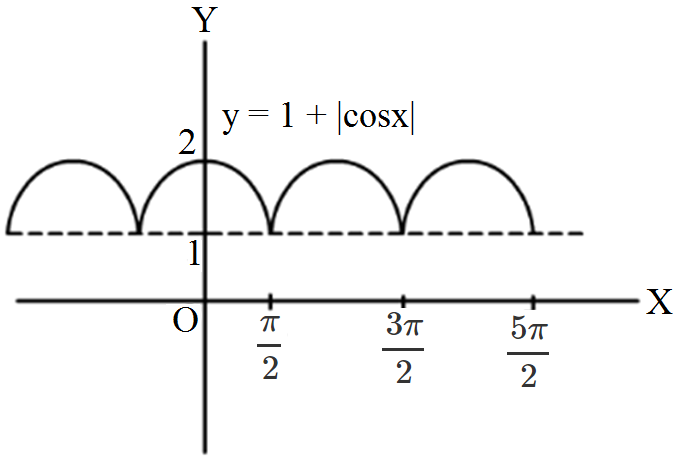
Graph of the function $\text{f(x)}=1+|\cos\text{x}|$ is as show blow:


From the graph, we can see that f(x) is everywhere continuous but not differentiable at $\text{x}=(2\text{n}+1)\frac{\pi}{2},\text{n}\in\text{Z}.$

Need a full question paper?

Generate a complete, print-ready paper with questions like this in minutes — across 16+ boards, with answer keys.

Start Generating Free

Similar questions

The equation of the plane parallel to the lines x - 1 = 2y - 5 = 2z and 3x = 4y - 11 = 3z -4 and passing through the point (2, 3, 3) is:
Three balls are drawn at random from a bag containing $5$ blue and $4$ yellow balls. Let the random variables $\mathrm{X}$ and $\mathrm{Y}$ respectively denote the number of blue and Yellow balls. If $\bar{X}$ and $\bar{Y}$ are the means of $X$ and $Y$ respectively, then $7 \bar{X}+4 \bar{Y}$ is equal to ..........
Let a vector $\vec{a}$ be coplanar with vectors $\vec{b}=2 \hat{i}+\hat{j}+\hat{k}$ and $\vec{c}=\hat{i}-\hat{j}+\hat{k} .$ If $\vec{a}$ is perpendicular to $\vec{d}=3 \vec{i}+2 \hat{j}+6 \hat{k}$, and $|\vec{a}|=\sqrt{10} .$ Then a possible value of $[\overrightarrow{\mathrm{a}} \overrightarrow{\mathrm{b}} \overrightarrow{\mathrm{c}}]+[\overrightarrow{\mathrm{a}} \overrightarrow{\mathrm{b}} \vec{d}]+[\overrightarrow{\mathrm{a}} \vec{c} \vec{d}]$ is equal to:
If $S$ is the sum of the first $10$ terms of the series $\tan ^{-1}\left(\frac{1}{3}\right)+\tan ^{-1}\left(\frac{1}{7}\right)+\tan ^{-1}\left(\frac{1}{13}\right)+\tan ^{-1}\left(\frac{1}{21}\right)+\ldots$ then $\tan ( S )$ is equal to
The order of the differential equation whose solution is $y = a\cos x + b\sin x + c{e^{ - x}}$ is
The area of the region bounded by the curves $y =| x – 2 |, x = 1, x = 3$ and the $x-$axis is:
The curve $\text{y}=\text{x}^{\frac{1}{5}}$ has at $(0, 0)$
The domain of $f(x) = [\sin x] \cos \left( {\frac{\pi }{{[x - 1]}}} \right)$ is (where $[.]$ denotes $G.I.F.$)
Area bounded by the parabola ${y^2} = 2x$ and the ordinates $x = 1,x = 4$ is
The solution of $\frac{\text{dy}}{\text{dx}}=1+\text{x}+\text{y}+\text{xy}$ is: