MCQ
The $\gamma\ \text{radiations}$ are:
- AElectromagnetic radiation with high energy.
- BElectromagnetic radiation with low energy.
- CCharged particles emitted by the nucleus.
- DElectrons orbiting the nucleus.
Generate a complete, print-ready paper with questions like this in minutes — across 16+ boards, with answer keys.
A positively charged ball hangs from a silk thread. We put a positive test charge  at a point and measure F/, then it can be predicted that the electric field strength E
|
(a) |
(b) |
(c) |
(d) Cannot be estimated |
A potentiometer consists of a wire of length 4 m and resistance 10Ω. It is connected to a cell of e.m.f. 2 V. The potential difference per unit length of the wire will be
|
(a) 0.5 V/m |
(b) 2 V/m |
(c) 5 V/m |
(d) 10 V/m |
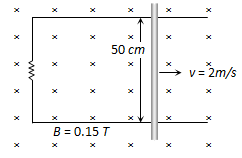
As shown in the figure a metal rod makes contact and complete the circuit. The circuit is perpendicular to the magnetic field with B = 0.15 tesla. If the resistance is 3Ω, force needed to move the rod as indicated with a constant speed of 2m/sec is
|
(a) 3.75 |
(b) 3.75 |
(c) 3.75 |
(d) 3.75 |
If a = 0.98 and current through emitter ie = 20 mA, the value of b is
|
(a) 4.9 |
(b) 49 |
(c) 96 |
(d) 9.6 |
A certain piece of silver of given mass is to be made like a wire. Which of the following combination of length (L) and the area of cross-sectional (A) will lead to the smallest resistance
|
(a) L and A |
|
(b) 2L and A/2 |
|
(c) L/2 and 2 A |
|
(d) Any of the above, because volume of silver remains same |
Sum of the two binary numbers  and
and  is
is
|
(a) |
(b) |
(c) |
(d) |
The continuous X-rays spectrum produced by an X-ray machine at constant voltage has
| (a) A maximum wavelength | (b) A minimum wavelength |
|
(c) A single wavelength |
(d) A minimum frequency |


