MCQ
The general formula of monohydric alcohol is :
  • A
    $C _n H _{2 n+1} O _2$
  • B
    $C _n H _{2 n+2} OH$
  • $C _n H _{2 n+2}$
  • D
    $C _n H _{2 n} OH$

Answer

Correct option: C.
$C _n H _{2 n+2}$
c

Need a full question paper?

Generate a complete, print-ready paper with questions like this in minutes — across 16+ boards, with answer keys.

Start Generating Free

Similar questions

The correct match between Item $I$ and Item $II$ is

Item $I$ Item $II$
$A$ Ester test $P$ Tyr
$B$ Carbylamine test $Q$ Asp
$C$ Phthalein dye test $R$ Ser
  $S$ Lys


Trichloroacetaldehyde, $CCl_3CHO$ reacts with chlorobenzene in presence of sulphuric acid and produces
Reduction of nitrobenzene by which of the following reagent gives aniline?
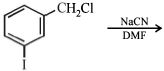
The structure of the major product formed in the following reaction is
Combination of which parameter explain more oxidising strength of $F_2$ as compared to $Cl_2$ in water:
Which polymer have $C-O-C$ linkage
The electrons which take part in order to exhibit variable oxidation states by transition metals are
Match List $I$ with List $II$.

List $I$ List $II$
$A$ van't Hoff factor, $i$ $I$ Cryoscopic constant
$B$ $k _{ f }$ $II$ Isotonic solutions
$C$ Solutions with same osmotic pressure $III$ $\frac{Normal\,molar\,mass}{Abnormal\,molar\,mass}$
$D$ Azeotropes $IV$ Solutions with same composition of vapour above it

Choose the correct answer from the options given below :

When a certain conductivity cell was filled with $0.1\,M\,KCl$ , it had a resistance of $85\,\Omega $ at $25\,^oC$ . When the same cell was filled with an aqueous solution of $0.052\,M$ unknown electrolyte, the resistance was $96\,\Omega $ . Calculate the molar conductivity of the unknown electrolyte at this concentration ............. ${\Omega ^{ - 1}}{\rm{c}}{{\rm{m}}^2}{\rm{mo}}{{\rm{l}}^{ - 1}}$ (Given : Specific conductance of $0.1\,M\,KCl = 1.29 \times 10^{-2}\,\Omega ^{-1}\,cm^{-1}$ )
${E^o}$ values of $M{g^{2 + }}/Mg$ is $ - 2.37\,V$, of $Z{n^{2 + }}/Zn$ is $ - 0.76\,V$ and $F{e^{2 + }}/Fe$ is $ - 0.44\,V$. Which of the following statements is correct