MCQ
The general formula ${(RCO)_2}O$ represents
  • A
    An ester
  • B
    A ketone
  • C
    An ether
  • An acid anhydride

Answer

Correct option: D.
An acid anhydride
d
$2RCOOH\xrightarrow{{ - {H_2}O}}\mathop {{{(RCO)}_2}O}\limits_{{\text{Acid}}\,{\text{anhydride}}} $

Need a full question paper?

Generate a complete, print-ready paper with questions like this in minutes — across 16+ boards, with answer keys.
Start Generating Free

Similar questions

For the reaction ; $2{A_{\left( s \right)}} + B_{\left( {aq} \right)}^{2 + } \to 2A_{\left( {aq} \right)}^ +  + {B_{\left( s \right)}}$ , Nernst equation for the $EMF$ of the cell is
Amphibole silicate structure has $'x'$ number of corner shared per tetrahedron. The value of $'x'$ is
If one strand of a $DNA$ has the sequence $ATGCTTCA$, sequence of the bases in complementary strand is:
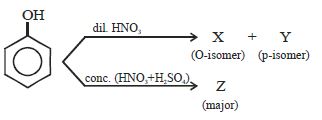
The order of acidic strength of $X, Y$ and $Z$ is
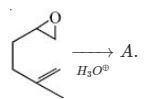
$‘A’$ is
$\mathop {Ph - MgBr}\limits^{{\text{[Excess]}}}       + $ $\begin{array}{*{20}{c}}
  {O\,\,\,\,} \\ 
  {||\,\,\,\,} \\ 
  {Cl - C - C{H_3}} 
\end{array}$ $\xrightarrow{{2{H^ \oplus }}}$ 

Final proudct of above reaction

For the first order reaction $A \rightarrow 2 B, 1$ $mole$ of reactant $A$ gives $0.2$ moles of $B$ after $100\, minutes.$

The half life of the reaction is $.....\,min$ [Use $: \ln 2=0.69, \ln 10=2.3$

Properties of logar $\ln \left(\frac{\mathrm{x}}{\mathrm{y}}\right)=\ln \mathrm{x}-\ln \mathrm{y}$

Which of the following statements is correct
A dilute solution of sulphuric acid is electrolysed using a current of $0.10 \,A$ for $2\, hours$ to produce hydrogen and oxygen gas. The total volume of gases produced at $STP$ is $......\,cm ^{3}$. (Nearest integer) $\lfloor$ Given : Faraday constant $F=96500 \,C$ $mol^{-1}$ at $STP,$ molar volume of an ideal gas is $\left.22.7\, L\, mol^{-1}\right]$
Given below are two statements :

Statement $(I)$ : Kjeldahl method is applicable to estimate nitrogen in pyridine.

Statement $(II)$ : The nitrogen present in pyridine can easily be converted into ammonium sulphate in Kjeldahl method.

In the light of the above statements, choose the correct answer from the options given below.