MCQ
The general solution of the differential equation $\frac{\text{dy}}{\text{dx}}=\text{e}^{\text{x}+\text{y}}\text{is}$
  • $\text{e}^{\text{x}}+\text{e}^{-\text{y}}=\text{C}$
  • B
    $\text{e}^{\text{x}}+\text{e}^{\text{y}}=\text{C}$
  • C
    $\text{e}^{-\text{x}}+\text{e}^{\text{y}}=\text{C}$
  • D
    $\text{e}^{-\text{x}}+\text{e}^{-\text{y}}=\text{C}$

Answer

Correct option: A.
$\text{e}^{\text{x}}+\text{e}^{-\text{y}}=\text{C}$
The given differential equation is

$\frac{\text{dy}}{\text{dx}}=\text{e}^{\text{x+y}}\ \ \text{or}\ \ \frac{\text{dy}}{\text{dx}}=\text{e}^{\text{x}}.\text{e}^{\text{y}}$

Separating the variables, we get,

$\frac{1}{\text{e}^{\text{y}}}\text{dy}=\text{e}^\text{x}\ \text{dx}$

$\text{Integrating},\ \int\text{e}^{-\text{y}}\text{dy}=\int\text{e}^\text{x}\ \text{dx}$

$\therefore\ \frac{\text{e}^{-\text{y}}}{-1}=\text{e}^\text{x}+\text{c}'$

$\therefore\ -\text{e}^{-\text{y}}=\text{e}^\text{x}+\text{c}'\ \ \text{or}\ \ \text{e}^\text{x}+\text{e}^{-\text{y}}=-\text{c}'$

$\therefore\ \text{e}^{\text{x}}+\text{e}^{-\text{y}}=\text{C},$ which is required solution.

Need a full question paper?

Generate a complete, print-ready paper with questions like this in minutes — across 16+ boards, with answer keys.

Start Generating Free

Similar questions

On the power set P of a non-empty set A, we define an operation $\triangle \text{ by }\text{X}\triangle\text{Y}=(\text{X}\cap\text{Y})∪(\text{X}∩\text{Y})\text{X}\triangle\text{Y}=\text{X}∩\text{Y}∪\text{X}∩\text{Y}$
Then which are of the following statements is true about $\triangle$
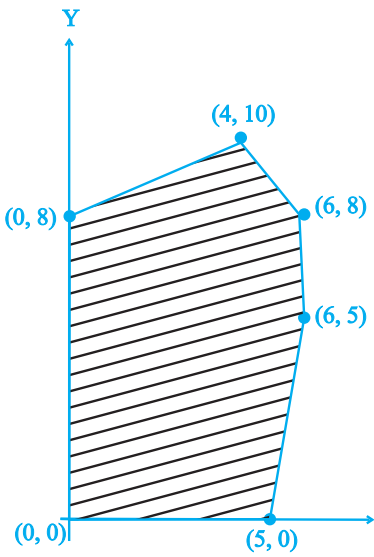
Choose the correct answer from the given four options. The feasible solution for a $\text{LPP}$ is shown in. Let $Z = 3x - 4y$ be the objective function.

Minimum of $Z$ occurs at :
The value of $\big[\vec{\text{a}}-\vec{\text{b}},\vec{\text{b}}-\vec{\text{c}},\vec{\text{c}}-\vec{\text{a}}\big],$ where $\big|\vec{\text{a}}\big|=1,\big|\vec{\text{b}}\big|=5,\big|\vec{\text{c}}\big|=3,$ is:
The distance of the line $\vec{\text{r}}=2\hat{\text{i}}-2\hat{\text{j}}+3\hat{\text{k}}+\lambda(\hat{\text{i}}-\hat{\text{j}}+4\hat{\text{k}})$ from the plane $\vec{\text{r}}.(\hat{\text{i}}+5\hat{\text{j}}+\hat{\text{k}})=5$ is:
$\int_{}^{} {\frac{{dx}}{{x[{{(\log x)}^2} + 4\log x - 1]}}} = $
If two sides of a triangle be given, then the area of the triangle will be maximum if the angle between the given sides be
Choose the correct answer from the given four options.
If the set A contains 5 elements and the set B contains 6 elements, then the number of one-one and onto mappings from A to B is:
Choose the correct answer from the given four option.The integrating factor of the differential equation $\frac{\text{d}\text{y}}{\text{d}\text{x}}+\text{y}=\frac{1+\text{y}}{\text{x}}$ is:
Differential coefficient of $\sqrt {\sec \sqrt x } $ is
For every point $P(x, y, z)$ on the $x-$ axis $($except the origin$),$