Question
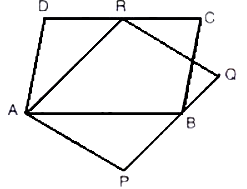
The given figure shows the parallelograms $\text{ABCD}$ and $\text{APQR}$.Show that these parallelograms are equal in the area.$[$Join $B$ and $R]$
Answer

Join $B$ and $R$ and $P$ and $R.$
We know that the area of the parallelogram is equal to twice the area of the triangle if the triangle and the parallelogram are on the same base and between the parallels.
Consider $\text{ABCD}$ parallelogram:Since the parallelogram $\text{ABCD}$ and the $\triangle ABR$ lie on $AB$ and between the parallels $AB$ and $DC,$ we have
Area$(\square ABCD )=2 \times$ Area$(\triangle ABR )\dots ....(1)$
We know that the area of triangles with the same base and between the same parallel lines are equal.
Since the triangles $\text{ABR}$ and $\text{APR}$ lie on the same base $AR$ and between the parallels $AR$ and $QP,$ we have,
Area $( ΔABR ) =$ Area $( ΔAPR ) \dots....(2)$
From equations $(1)$ and $(2)$, we have,
Area$(\square ABCD )=2 \times$ Area$(\triangle APR ) \dots.....(3)$
Also, the $\triangle APR$ and the parallelograms, $AR$ and $QR,$ lie on the same base $AR$ and between the parallels, $AR$ and $QP,$
Area($\triangle APR )=\frac{1}{2} \times$ Area$(\square ARQP ) \dots....(4)$
Using $(4)$ in equation $(3),$ We have,
Area$(\square ABCD )=2 \times \frac{1}{2} \times$ Area$(\square ARQP )$
Area$(\square ABCD )=$Area$(\square ARQP )$
Hence Proved.

Need a full question paper?

Generate a complete, print-ready paper with questions like this in minutes — across 16+ boards, with answer keys.
Start Generating Free

Similar questions

The sum of a two digit number and the number obtained by reversing the order of the digits is $99.$ Find the number, if the digits differ by $3.$
Image
In the given figure, ABCD is a rectangle inscribed in a circle. If two adjacent sides of the rectangle be 8 cm and 6 cm, calculate :
(i) the radius of the circle; and
(ii) the area of the shaded region. (Take $\pi$ = 3.14 ).
$\left[\right.$ Hint. Radius $=\left(\frac{1}{2} \times\right.$ Diagonal $\left.)=5 cm\right]$
Calculate the amount and the compound interest on:$Rs. 16,000$ in $3$ years, when the rates of the interest for successive years are $10\%, 14\%$ and $15\%$ respectively.
Solve for $\mathbf{x}: \frac{\log 64}{\log 8}=\log x$
Evaluate the following:$\frac{2^3 \times 3^5 \times 24^2}{12^2 \times 18^3 \times 27}$
If 11 pens and 19 pencils together cost ₹ 502; while 19 pens and 11 pencils together cost ₹ 758, how much 3 pens and 6 pencils cost together?
Construct a rhombus, having given one side $= 4.8 \ cm$ and one angle $= 75^o.$
By drawing a graph for each of the equations $3x + y + 5 = 0; 3y - x = 5$ and $2x + 5y = 1$ on the same graph paper; show that the lines given by these equations are concurrent $($i.e. they pass through the same point$)$. Take $2 \ cm = 1$ unit on both the axes.
The present age of a man is double the age of his son. After $8$ years, the ratio of their ages will be $7:4.$ Find the present ages of the man and his son.
Find the discount percentage in the following:$M.P. = Rs. 6840, S.P. = Rs. 5814$