Question
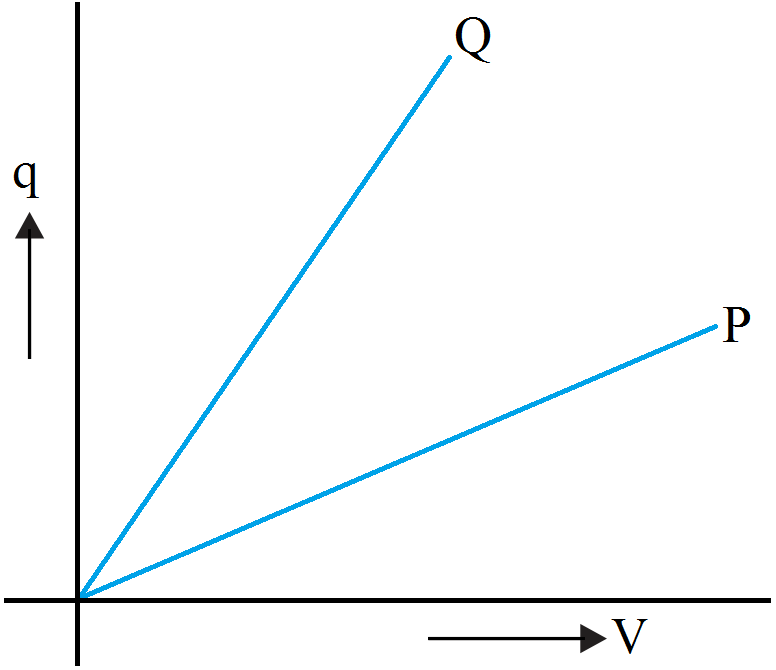
The given graph shows the variation of charge $q$ versus potential difference $V$ for two capacitors $C_1$ and $C_2.$ The two capacitors have same plate separation but the plate area of $C_2$ is double than that of $C_1.$ Which of the two graphs $P$ and $Q$ correspond to capacitors $C_1$ and $C_2$ and why?
Answer

$Q$ represents $C_2$ and $P$ represents $C_1,$
Reason: From the graph the slope $\frac{\text{q}}{\text{V}}$ Capacitance is greater for $Q.$
Also according to given conditions the capacitance $\frac{\varepsilon\text{A}}{\text{d}}$ is larger for the $C_2$ because the area of its plates is large and $d$ for the two capacitors is same.
​​​​​​​Hence, $Q$ represents $C_2.$

Need a full question paper?

Generate a complete, print-ready paper with questions like this in minutes — across 16+ boards, with answer keys.

Start Generating Free

Similar questions

If three identical prisms are combined, is it possible to pass a beam that emerges undeviated? Undispersed?
The decay constant of $\text{ }^{197}_{80}\text{Hg} ($electron capture to $\text{ }^{197}_{79}\text{Au})$ is $1.8 \times 10^{-4} S^{-1}.$
  1. What is the half-life$?$
  2. What is the average-life$?$
  3. How much time will it take to convert $25\%$ of this isotope of mercury into gold$?$
Consider the situation shown in figure. The switch is closed at $t = 0$ when the capacitors are uncharged. Find the charge on the capacitor $C_1$ as a function of time $t$.
An electric field $\vec{\text{E}}=\vec{\text{i}}\text{Ax}$ exists in the space, where $A= 10Vm^{-2}.$ Take the potential at $(10m, 20m)$ to be zero. Find the potential at the origin.
The temperatures of the junctions of a bismuth$-$silver thermocouple are maintained at $0^\circ C$ and $0.001^\circ C$. Find the thermo-emf $($Seebeck emf$)$ developed. For bismuth$-$silver$, a = -46 \times 10^{-6}V^\circ C-^1$ and $b = -0.48 \times 10^{-6} V^\circ C^{-2}.$
When are two objects just resolved? Explain. How can the resolving power of a compound microscope be increased? Use relevant formula to support your answer.
Write down the difference between a half wave rectifier and a full wave rectifier.
Explain the arrangment of Geiger-Marsden's experiment of $\alpha$-particle scattering.
Define lens and write its formula.
A light bulb is rated at $100 W$ for a $220 V$ supply. Find (a) the resistance of the bulb; (b) the peak voltage of the source; and (c) the rms current through the bulb.