MCQ
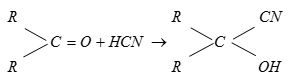
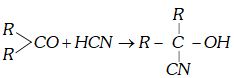
The given Reaction is
  • A
    Electrophilic substitution
  • B
    Electrophilic addition
  • Nucleophilic addition
  • D
    Nucleophilic substitution

Answer

Correct option: C.
Nucleophilic addition
c
(c) is an example of nucleophilic addition reaction.

Need a full question paper?

Generate a complete, print-ready paper with questions like this in minutes — across 16+ boards, with answer keys.

Start Generating Free

Similar questions

Main constituent of dynamite is
The concentration of a reactant decreases from $0.2\,M$  to $0.1\,M$  in $10$  minutes. The rate of the reaction is
$pH$ at isoeletric point of three amino acids are given as follow.

    $pH$ at Isoelectric point
$(Amino acid)_I$   $6$ 
$(Amino acid)_{II}$ $9.8$
$(Amino acid)_{III}$  $3.9$

$(Amino acid)_{II}$ is ____ ?

 $A + B \to $ products, it is found that the rate of the reaction is proportional to the concentration of $A,$  but it is independent of the concentration of $B$, then
Find structure which has an organic acid functional group:
$1 \times 10^{-5}\,M \textrm {AgNO } _ { 3 }$ is added to $1\,L$ of saturated solution of $AgBr$. The conductivity of this solution at $298\,K$ is $.........\times 10^{-8}\,S\,m ^{-1}$

$\left[\right.$ Given : $K _{ sp }( AgBr )=4.9 \times 10^{-13}$ at $298 K$

$\lambda_{ Ag ^{+}}^0=6 \times 10^{-3} Sm ^2\,mol ^{-1}$

$\lambda_{ Br ^{-}}^0=8 \times 10^{-3} Sm ^2\,mol ^{-1}$

$\left.\lambda_{ NO _3^{-}}^0=7 \times 10^{-3} Sm ^2\,mol ^{-1}\right]$

In the dehydrohalogenation of $2$ -bromobutane; which conformation leads to the  formation of $cis-2$ -butene ?
For the given reaction

$\begin{array}{*{20}{c}}
  {\begin{array}{*{20}{c}}
  {\,\,{R_1}} \\ 
  | 
\end{array}} \\ 
  {R - C - X} \\ 
  | \\ 
  {\,\,{R_2}} 
\end{array}\xrightarrow{{HOH}}\begin{array}{*{20}{c}}
  {\begin{array}{*{20}{c}}
  {\,\,{R_1}} \\ 
  | 
\end{array}\,\,\,\,\,} \\ 
  {R - C - OH} \\ 
  {|\,\,\,} \\ 
  {{R_2}} 
\end{array}$

Which substrate will give maximum racemisation?

In which of the following, oxygen has $+ 2$ oxidation number
Mark the element which shows only one oxidation state