MCQ
The given reaction is
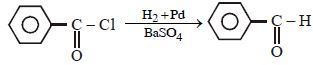
- AMendius reaction
- BStephen's reaction
- ✓Rosenmund's reduction
- DCannizzaro's reaction
Generate a complete, print-ready paper with questions like this in minutes — across 16+ boards, with answer keys.
$\mathop {\begin{array}{*{20}{c}}
{OH\,\,\,\,\,\,\,\,\,\,\,\,\,\,\,\,\,\,\,\,\,\,\,O} \\
{|\,\,\,\,\,\,\,\,\,\,\,\,\,\,\,\,\,\,\,\,\,\,\,\,\,\,\,\,||} \\
{C{H_2} = C - C{H_2} - C - C{H_3}}
\end{array}}\limits_{(I)} \rightleftharpoons $
$\mathop {\begin{array}{*{20}{c}}
{OH\,\,\,\,\,\,\,\,\,\,\,\,\,\,\,\,\,\,\,O} \\
{|\,\,\,\,\,\,\,\,\,\,\,\,\,\,\,\,\,\,\,\,\,\,\,\,\,||} \\
{C{H_3} - C - C{H_2} - C - C{H_3}}
\end{array}}\limits_{(II)} \rightleftharpoons $
$\mathop {\begin{array}{*{20}{c}}
{OH\,\,\,\,\,\,\,\,\,\,\,\,\,\,\,\,\,\,\,O} \\
{|\,\,\,\,\,\,\,\,\,\,\,\,\,\,\,\,\,\,\,\,\,\,\,\,\,||} \\
{C{H_3} - C = CH - C - C{H_3}}
\end{array}}\limits_{(III)} $
$\underset{1}{\mathop{\begin{matrix}
O\,\,\,\,\,\,\,\,\,\,\,\, \\
||\,\,\,\,\,\,\,\,\,\,\,\,\, \\
C{{H}_{3}}COCHC{{H}_{3}} \\
\end{matrix}}}\,$ $\underset{2}{\mathop{\begin{matrix}
\,\,\,\,O \\
\,\,\,\,|| \\
C{{H}_{3}}CCl \\
\end{matrix}}}\,$ $\underset{3}{\mathop{\begin{matrix}
O\,\,\,\,\,\,\,\,\, \\
||\,\,\,\,\,\,\,\,\, \\
C{{H}_{3}}CNHC{{H}_{3}} \\
\end{matrix}}}\,$
$A$. They exhibit high enthalpy of atomization as the d-subshell is full.
$B$. $\mathrm{Zn}$ and $\mathrm{Cd}$ do not show variable oxidation state while $\mathrm{Hg}$ shows $+\mathrm{I}$ and + $II.$
$C$. Compounds of $\mathrm{Zn}, \mathrm{Cd}$ and $\mathrm{Hg}$ are paramagnetic in nature.
$D$. $\mathrm{Zn}, \mathrm{Cd}$ and $\mathrm{Hg}$ are called soft metals.
Choose the most appropriate from the options given below:
If all products formed in the above reaction undergo reaction with $Br_2(CCl_4)$ individually then number of products formed will be :