MCQ
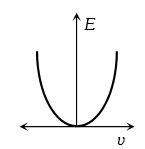
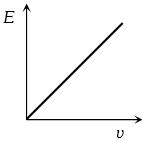
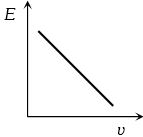
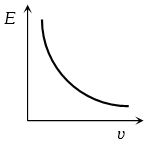
The graph between $E$ and $v$ is

  • B

  • C

  • D

Answer

Correct option: A.

a
(a)Kinetic energy $E = \frac{1}{2}m{v^2}$$⇒$ $E \propto {v^2}$
graph will be parabola symmetric to $E-$axis.

Need a full question paper?

Generate a complete, print-ready paper with questions like this in minutes — across 16+ boards, with answer keys.
Start Generating Free

Similar questions

Which is incorrect
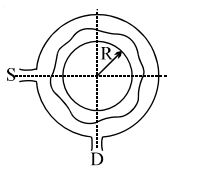
 A narrow tube is bent in the form of a circle of radius $R,$ as shown in the figure. Two small holes $S$ and $D$ are made in the tube at the positions right angle to each other. A source placed at $S$ generated a wave of intensity $I_0$ which is equally divided into two parts : One part travels along the longer path, while the other travels along the shorter path. Both the part waves meet at the point $D$ where a detector is placed If a maxima is formed at the detector then, the magnitude of wavelength $\lambda$ of the wave produced is given by $\pi R$
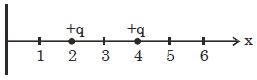
Two charged particles, each with a charge of $+q$, are located along the $x$ -axis at $x = 2$ and $x = 4$, as shown below. Which of the following shows the graph of the magnitude of the electric field along the $x$ -axis from the origin to $x = 6$?
A lead bullet of $10\,g$ travelling at $300\,m/s$ strikes against a block of wood and comes to rest. Assuming $50\,\%$ of heat is absorbed by the bullet, the increase in its temperature is ........ $^oC$ (Specific heat of lead $= 150\,J/kg,\,K$ )
A circuit has a resistance of $12 \;\Omega$ and an impedance of $15 \;\Omega$. The power factor of the circuit will be
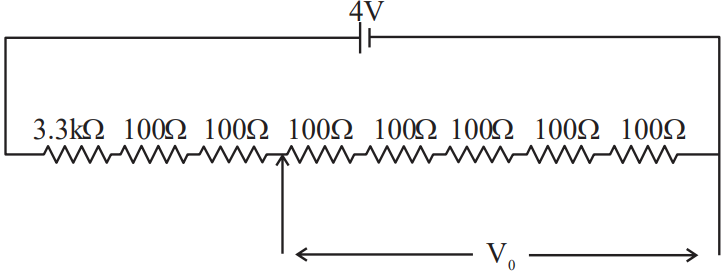
A potential divider circuit is shown in figure. The output voltage $V _0$ is
Image
Two identical metallic spheres $A$ and $B$ when placed at certain distance in air repel each other with a force of $F$. Another identical uncharged sphere $C$ is first placed in contact with $A$ and then in contact with $B$ and finally placed at midpoint between spheres $A$ and $B$. The force experienced by sphere $C$ will be.
Choose the correct match

List I 

List II

 $(i)$ Curie

 $(A)$ $ML{T^{ - 2}}$

 $(ii)$ Light year 

 $(B)$ $M$

 $(iii)$ Dielectric strength

 $(C)$ Dimensionless

 $(iv)$ Atomic weight

 $(D)$ $T$

 $(v)$ Decibel

 $(E)$ $M{L^2}{T^{ - 2}}$


 $(F)$ $M{T^{ - 3}}$


 $(G)$ ${T^{ - 1}}$


 $(H)$ $L$


 $(I)$ $ML{T^{ - 3}}{I^{ - 1}}$


 $(J)$ $L{T^{ - 1}}$

The magnifying power of a compound microscope increases when
Assertion: A double convex lens $(\mu = 1.5)$ has focal length $10\,cm$. When the lens is immersed in water $(\mu = 4/3)$ its focal length becomes $40\,cm$

Reason: $\frac{1}{f} = \frac{{{\mu _1} - {\mu _m}}}{{{\mu _m}}} \left( {\frac{1}{{{R_1}}} - \frac{1}{{{R_2}}}} \right)$