MCQ
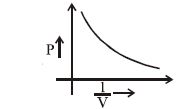
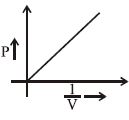
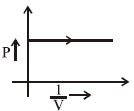
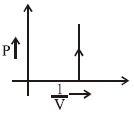
The graph between pressure $(P)$ and $\frac{1}{V}$ ($V$ is volume) for constant temperature process in ideal equation  $(PV = nRT)$
  • A


  • C

  • D

Answer

Correct option: B.

b
$P = nRT\left( {\frac{1}{V}} \right)$

$y = mx$

Need a full question paper?

Generate a complete, print-ready paper with questions like this in minutes — across 16+ boards, with answer keys.
Start Generating Free

Similar questions

Two metallic spheres ${S_1}$ and ${S_2}$are made of the same material and have identical surface finish. The mass of ${S_1}$ is three times that of ${S_2}$. Both the spheres are heated to the same high temperature and placed in the same room having lower temperature but are thermally insulated from each other. The ratio of the initial rate of cooling of ${S_1}$ to that of ${S_2}$ is
A star is modeled as a uniform spherical distribution of matter keeping mass of star constant. How gravitational pressure on surface depends on volume of the star?
A rocket has to be launched from each in such a way that it never returns. If $E$ is the minimum energy delivered by the rocket launcher, what should be the minimum energy that the launcher should have if the same rocket is to be launched from the surface of the moon ? Assume that the density of the earth and the moon are equal and that the earth’s volume is $64$ times the volume of the moon.
Light waves travel in vacuum along the X-axis. Which of the following may represent the wavefronts?
  1. x = c.
  2. y = c.
  3. z = c.
  4. x + y + z = c.
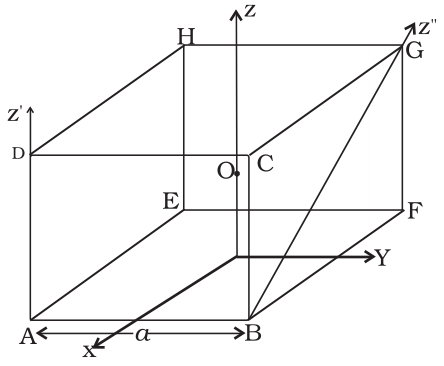
With reference to of a cube of edge a and mass m, state whether the following are true or false. (O is the centre of the cube.)

An object of mass $1 \,kg$ moving on a horizontal surface with initial velocity $8 \,m / s$ comes to rest after $10 \,s$. If one wants to keep the object moving on the same surface with velocity $8 \,m / s$ the force required is ...... $N$
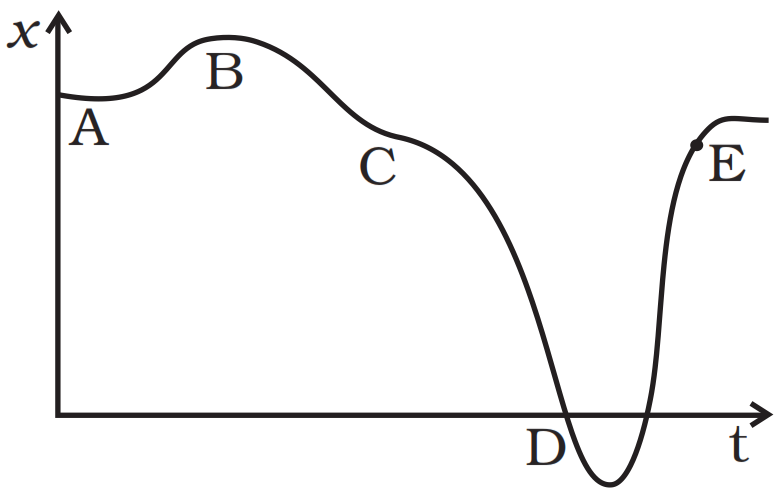
A graph of x versus t is shown in Fig. Choose correct alternatives from below:

The relation between phase difference  $ (\Delta \phi) $ and path difference $ (\Delta x) $ is
An engine pumps water continuously through  a hose. Water leaves the hose with a velocity $v$ and $m$ is the mass per unit length of the water jet. What is the rate at which kinetic energy is imparted to water $?$
An ideal gas follows a process described by $p V^2=C$ from $\left(p_1, V_1, T_1\right)$ to $\left(p_2, V_2, T_2\right)$ and $C$ is a constant. Then,