Question
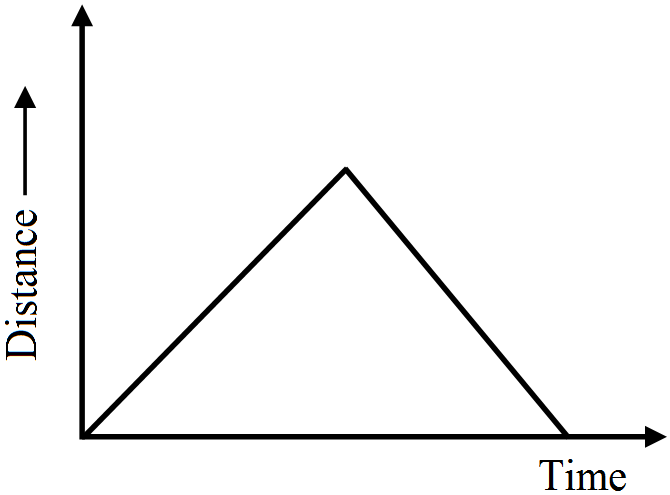
The graph between total path length and time for a particle moving along a straight line as shown in figure is not possible. Explain why?
Answer

The graph shows that with the passage of time, total path length first increases and then decreases.
The path length always increases or remains constant with passage of time and it does not decrease with time as shown in figure. Thus, this graph is not possible.

Need a full question paper?

Generate a complete, print-ready paper with questions like this in minutes — across 16+ boards, with answer keys.
Start Generating Free

Similar questions

A hydrogen atom in a state having a binding energy of 0.85eV makes transition to a state with excitation energy 10.2eV (a) Identify the quantum numbers n of the upper and the lower energy states involved in the transition. (b) Find the wavelength of the emitted radiation.
Why it is much hotter above a fire than by its side?
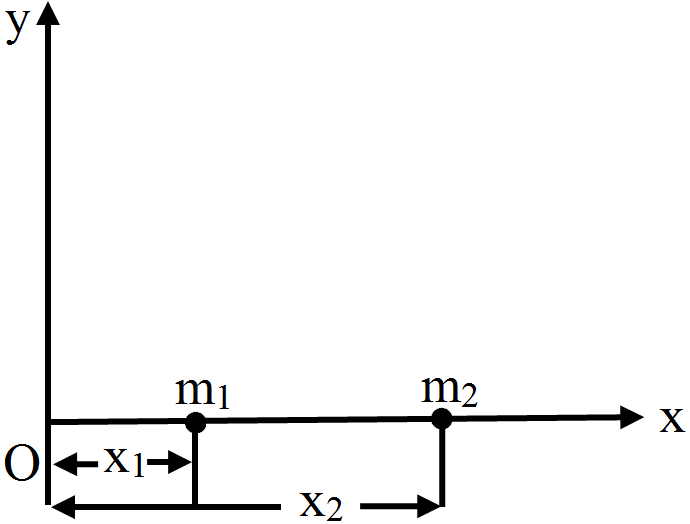
What will be the centre of mass of the pair of particles described below in figure on the x-axis?

A wooden block of mass 0.5kg and density 800kg/m3 is fastened to the free end of a vertical spring of spring constant 50N/m fixed at the bottom. If the entire system is completely immersed in water, find.
  1. The elongation (or compression) of the spring in equilibrium and.
  2. The time-period of vertical oscillations of the block when it is slightly depressed and released.
The electric current in a discharging R-C circuit is given by $\text{i}=\text{i}_0\text{e}^{-\frac{\text{t}}{\text{RC}}}$ where i0, R and C are constant parameters and t is time. Let $\text{i}_0=2.00\text{A},\text{R}=600\times10^5\Omega$ and $\text{C}=0.500\mu\text{F}.$
  1. Find the current at t = 0.3s.
  2. Find the rate of change of current at t = 0.3s.
  3. Find approximately the current at t = 0.31s.
What is the Bulk modulus for a perfect rigid body?
For a satellite orbiting in an orbit, close to the surface of earth, to escape, what is the percentage increase in the kinetic energy required?
Differentiate between forced oscillations and supported oscillations.
Calculate the mass of 1cm3 of oxygen kept at STP.
Two identical cylinders 'run a race' starting from rest at the top of an inclined plane, one slides without rolling and other rolls without slipping. Assuming that no mechanical energy is dissipated in heat, which one will win?