MCQ
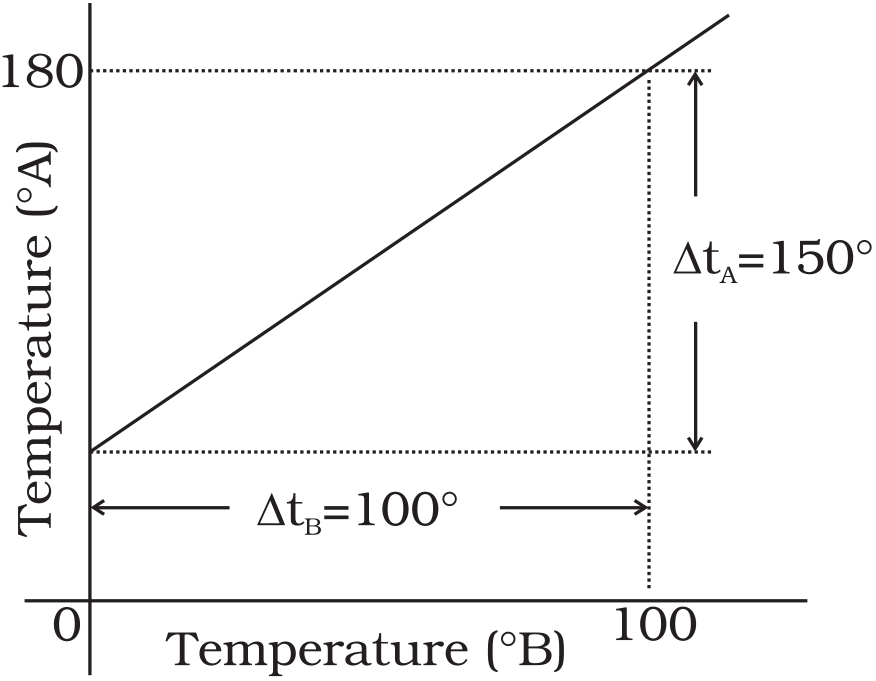
The graph between two temperature scales $A$ and $B$ is shown in between upper fixed point and lower fixed point there are $150$ equal division on scale $A$ and $100$ on scale $B$. The relationship for conversion between the two scales is given by:
  • A
    $\frac{\text{t}_\text{A}-180}{100}=\frac{\text{t}_\text{B}}{150}$
  • $\frac{\text{t}_\text{A}-30}{150}=\frac{\text{t}_\text{B}}{100}$
  • C
    $\frac{\text{t}_\text{B}-180}{150}=\frac{\text{t}_\text{A}}{100}$
  • D
    $\frac{\text{t}_\text{B}-40}{100}=\frac{\text{t}_\text{A}}{180}$

Answer

Correct option: B.
$\frac{\text{t}_\text{A}-30}{150}=\frac{\text{t}_\text{B}}{100}$
Key concept: Temperature on one scale can be converted into other scale by using the following identity.
$($image$)$
Reading on any scale $\frac{\text{LfP}}{\text{UFP}-\text{LFP}}=$ Constant for all scales
where, $\text{LFP} \rightarrow$ Lower fixed point
$\text{UFP} \rightarrow$ Upper fixed point
From the graph it is clear that the lowest point for scale $A$ is $30^\circ$ and highest point for the scale $A$ is $180^\circ$. Lowest point for scale $B$ is $0^\circ$ and highest point for scale $B$ is $100^\circ$ .
Hence, the relation between the two scales $A$ and $B$ is given by
$\frac{\text{T}_\text{A}-(\text{LFP})_\text{A}}{(\text{UFP)}_\text{A}-(\text{LFP})_\text{A}}=\frac{\text{T}_\text{B}-(\text{LFP})_\text{B}}{(\text{UFP)}_\text{B}-(\text{LFP})_\text{B}}$
$\Rightarrow\frac{\text{T}_\text{A}-30}{180-30}=\frac{\text{T}_\text{B}-0}{100-0}$
$\Rightarrow\frac{\text{t}_\text{A}-30}{150}=\frac{\text{t}_\text{B}}{100}$

Need a full question paper?

Generate a complete, print-ready paper with questions like this in minutes — across 16+ boards, with answer keys.

Start Generating Free

Similar questions

Two soap bubbles of radii $3r$ and $4r$ in contact with each other. The radius of curvature of the interface between bubbles is
A particle $P$ is moving in a circle of radius $'a'$ with a uniform speed $v$ . $C$ is the centre of the circle and $AB$ is a diameter. When passing through $B$ the angular velocity of $P$ about $A$ and $C$ are in the ratio 
How long will a train, running at a speed of $45\ kmph$ cross a standing man, given the length of the train is $450\ m\ ?$
What is ratio of surface energy of $1$ small drop and $1$ large drop, if $1000$ small drops combined to form $1$ large drop
Hanging in a spring m the period of oscillation of the mass is T. Oscillations are made by cutting the spring in half and hanging double the mass on it. Now the period of oscillation will be :
A man raises a box of mass $50\ kg$ to a height of $2m$ in $2\ \text{min}$ , while another man raises the same box to the same height in $5$ minthes. What is the ratio of work done by them?
The force required to stretch a spring varies with the distance as shown in the figure. If the experiment is performed with the above spring of half the length, the line Then will:
The muscles of a normal eye are least strained when the eye is focused on an object:
The kinetic energy of a particle executing $S.H.M.$ is $16\, J$ when it is at its mean position. If the mass of the particle is $0.32 \,kg$, then what is the maximum velocity of the particle ..... $m/s$
A black body radiates energy at the rate of $1 \times 10^5 J / s \times m^2$ at temperature of $227^o C$. The temperature to which it must be heated so that it radiates energy at rate of $1 \times 10^9J/s m^2$, is