Question
The graph shown here shows the variation of terminal potential difference V, across a combination of three cells in series to a resistor, versus current i:
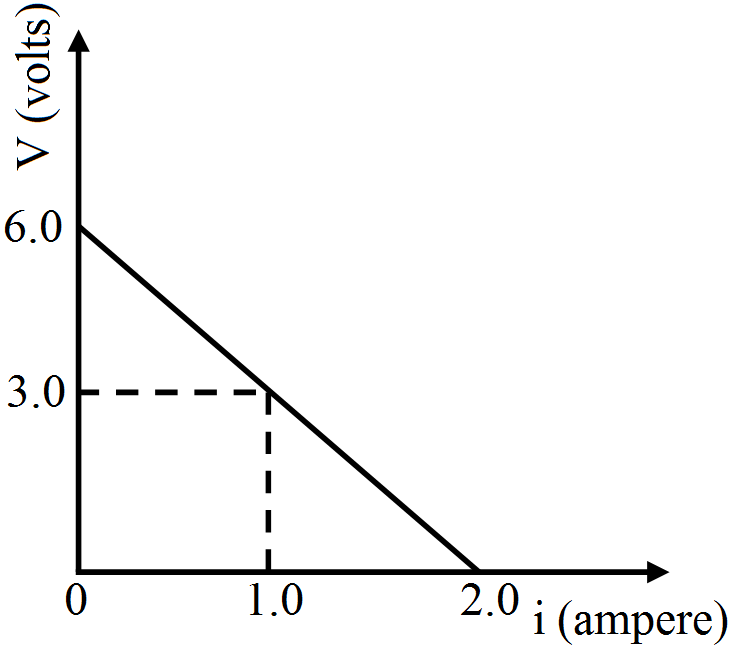
  1. Calculate the emf of each cell.
  2. For what current i, will the power dissipation of the circuit be maximum?

Answer

Let $\varepsilon$ be emf and r the internal resistance of each cell. The equation of terminal potential difference.
V = $\varepsilon$ eff - i rint becomes,
V = $3\varepsilon$ -i rint …(i)
Where rint is effective (total) internal resistance.
From fig., when i = 0, V = 6.0V
$\therefore$ From (i), $6=3\varepsilon-0\Rightarrow\varepsilon=\frac63=2\text{V}$
i.e., emf of each cell, $\varepsilon=2\text{V}$
Thus, emf of each cell, $\varepsilon=\text{2V}.$

Need a full question paper?

Generate a complete, print-ready paper with questions like this in minutes — across 16+ boards, with answer keys.

Start Generating Free

Similar questions

A lens forms a real image of an object. The distance from the object to the lens is u cm and the distance of the image from the lens is v cm. The given graphs shows variation of v with u.
  1. What is the nature of the lens?
  2. Using the graph, find the focal length of this lens.
A horizontal straight wire $10 m$ long extending from east to west is falling with a speed of $5.0 ms^{-1}$, at right angles to the horizontal component of the earth's magnetic field, $0.30 \times 10^{-4} Wb m ^{-2}$.
$a$. What is the instantaneous value of the emf induced in the wire?
$b$. What is the direction of the emf?
$c$. Which end of the wire is at the higher electrical potential?
A $60\mu F$ capacitor is connected to a $110V, 60Hz$ ac supply. Determine the rms value of the current in the circuit.
The fission properties of $^{239}_{94}\text{Pu}$ are very similar to those of $^{235}_{92}\text{U}.$ The average energy released per fission is $180 MeV$. How much energy, in $MeV,$ is released if all the atoms in $1 \ kg$ of pure $^{239}_{94}\text{Pu}$ undergo fission?
A circular coil of $200$ turns and radius $10 \ cm$ is placed in a uniform magnetic field of $0.5 T,$ normal to the plane of the coil. If the current in the coil is $3.0 A,$ calculate the
  1. Total torque on the coil.
  2. Total force on the coil.
  3. Average force on each electron in the coil, due to the magnetic field.
Assume the area of cross$-$section of the wire to be $10–5m^2$ and the free electron density is $10^{29}/m^3.$
A wire of length 1m and radius 0.1mm has a resistance of $100\Omega.$ Find the resistivity of the material.
  1. An $X-$ray tube produces a continuous spectrum of radiation with its short wavelength end at $0.45 \mathring A$ . What is the maximum energy of a photon in the radiation?
  2. From your answer to $(a),$ guess what order of accelerating voltage $($for electrons$)$ is required in such a tube?
In the given circuit, the potential difference across the inductor L and resistor R are 200V and 150V respectively and the rms. value of current is 5A. Calculate (i) the impedance of the circuit and (ii) the phase angle between the voltage and the current.
Draw a graph showing the variation of binding energy per nucleon with mass number of different nuclei. Write any two salient features of the curve. How does this curve explain the release of energy both in the processes of nuclear fission and fusion?
Let $\varepsilon_1$ and $\varepsilon_2$ be the angles made by $\overrightarrow{\text{A}}$ and $-\overrightarrow{\text{A}}$ with the positive X-axis. Show that $\tan\varepsilon_1=\tan\varepsilon_2.$ Thus, giving tane does not uniquely determine the direction of $\overrightarrow{\text{A}}.$