MCQ
The graph which represents the relation between the total resistance $R$ of a multi range moving coil voltmeter and its full scale deflection $V$ is
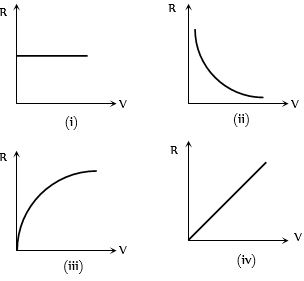
- A$(i)$
- B$(ii)$
- C$(iii)$
- ✓$(iv)$
$\frac{V}{{R + G}} = {i_g}$ $ \Rightarrow $ $\frac{V}{{{R_V}}} = {i_g}$;
where $R_V = R + G = $
Total resistance $ \Rightarrow $ ${R_V} = \frac{V}{{{i_g}}}$ $ \Rightarrow $ ${R_V} \propto V$
Generate a complete, print-ready paper with questions like this in minutes — across 16+ boards, with answer keys.
$1.$ A diatomic molecule has moment of inertia I. By Bohr's quantization condition its rotational energy in the $\mathrm{n}^{\text {th }}$ level ( $\mathrm{n}=0$ is not allowed) is
$(A)$ $\frac{1}{\mathrm{n}^2}\left(\frac{\mathrm{h}^2}{8 \pi^2 \mathrm{I}}\right)$ $(B)$ $\frac{1}{\mathrm{n}}\left(\frac{\mathrm{h}^2}{8 \pi^2 \mathrm{I}}\right)$
$(C)$ $n\left(\frac{h^2}{8 \pi^2 \mathrm{I}}\right)$ $(D)$ $\mathrm{n}^2\left(\frac{\mathrm{h}^2}{8 \pi^2 \mathrm{I}}\right)$
$2.$ It is found that the excitation frequency from ground to the first excited state of rotation for the $\mathrm{CO}$ molecule is close to $\frac{4}{\pi} \times 10^{11} \mathrm{~Hz}$. Then the moment of inertia of $\mathrm{CO}$ molecule about its centre of mass is close to (Take $\mathrm{h}=2 \pi \times 10^{-34} \mathrm{Js}$ )
$(A)$ $2.76 \times 10^{-46} \mathrm{~kg} \mathrm{~m}^2$ $(B)$ $1.87 \times 10^{-46} \mathrm{~kg} \mathrm{~m}^2$
$(C)$ $4.67 \times 10^{-47} \mathrm{~kg} \mathrm{~m}^2$ $(D)$ $1.17 \times 10^{-47} \mathrm{~kg} \mathrm{~m}^2$
$3.$ In a $\mathrm{CO}$ molecule, the distance between $\mathrm{C}$ (mass $=12$ a.m.u) and $\mathrm{O}$ (mass $=16$ a.m.u.), where $1$ a.m.u. $=\frac{5}{3} \times 10^{-27} \mathrm{~kg}$, is close to
$(A)$ $2.4 \times 10^{-10} \mathrm{~m}$ $(B)$ $1.9 \times 10^{-10} \mathrm{~m}$
$(C)$ $1.3 \times 10^{-10} \mathrm{~m}$ $(D)$ $4.4 \times 10^{-11} \mathrm{~m}$
Give the answer question $1,2$ and $3.$