MCQ
The graph which represents the relation between the total resistance $R$ of a multi range moving coil voltmeter and its full scale deflection $V$ is
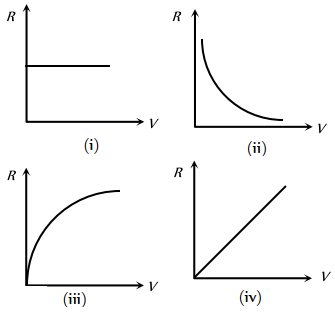
Image

  • A
    (i) (iii)
  • B
    (ii) (iv)
  • C
    (iii)
  • (iv)

Answer

Correct option: D.
(iv)
(d) For conversion of a galvanometer into a voltmeter$\begin{aligned}& \frac{V}{R+G}=i_g \Rightarrow \frac{V}{R_V}=i_g ; \text { where } R_v=R+G=\text { Total resistance } \\& \Rightarrow R_V=\frac{V}{i_g} \Rightarrow R_V \propto V\end{aligned}$

Need a full question paper?

Generate a complete, print-ready paper with questions like this in minutes — across 16+ boards, with answer keys.
Start Generating Free

Similar questions

Biological importance of Ozone layer is
A particle is dropped vertically from rest from a height. The time taken by it to fall through successive distances of $1 m$ each will then be
An ideal gas at a pressures of $1$ atmosphere and temperature of $27^{\circ} \mathrm{C}$ is compressed adiabatically until its pressure becomes $8$ times the initial pressure, then the final temperature is $(\gamma=3 / 2)$
Which of the following graphs represents the motion of a planet moving about the sun
What is the angle between $\vec{P}$ and the resultant of $(\vec{P}+\vec{Q})$ and $(\vec{P}-\vec{Q})$
When forces $F_1, F_2, F_3$ are acting on a particle of mass $m$ such that $F_2$ and $F_3$ are mutually perpendicular, then the particle remains stationary. If the force $F_1$ is now removed then the acceleration of the particle is
Dimensions of time in power are
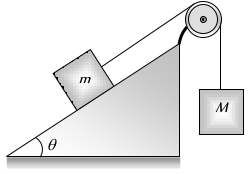
A wire of $9.8 \times 10^{-3} \mathrm{kgm}^{-1}$ passes over a frictionless light pulley fixed on the top of a frictionless inclined plane which makes an angle of $30^{\circ}$ with the horizontal. Masses $m$ and $M$ are tied at the two ends of wire such that $m$ rests on the plane and $M$ hangs freely vertically downwards. The entire system is in equilibrium and a transverse wave propagates along the wire with a velocity of $100 \mathrm{~ms}$. Chose the correct option

Image

Which of the following is not thermodynamical function
The length of a magnet is large compared to its width and breadth. The time period of its oscillation in a vibration magnetometer is $2 \mathrm{~s}$. The magnet is cut along its length into three equal parts and three parts are then placed on each other with their like poles together. The time period of this combination will be