Question
The gravitational attraction between electron and proton in a hydrogen atom is weaker than the coulomb attraction by a factor of about 10–40. An alternative way of looking at this fact is to estimate the radius of the first Bohr orbit of a hydrogen atom if the electron and proton were bound by gravitational attraction. You will find the answer interesting.
Answer

Radius of the first Bohr orbit is given by the relation,
$\text{r}_1=\frac{4\pi\in_0\Big(\frac{\text{h}}{2\pi}\Big)^2}{\text{m}_\text{e}\text{e}^2}\ \dots(1)$
Where,
$\in_0$ = Permittivity of free space
h = Planck ' s constant = 6.63 × 10⁻³⁴ Js
me = Mass of an electron = 9.1 × 10⁻³¹ kg
e = Charge of an electron = 1.9 × 10⁻¹⁹ C
mp = Mass of a proton = 1.67 × 10⁻²⁷ kg
r = Distance between the electron and the proton
Coulomb attraction between an electron and a proton is given as:
$\text{F}_\text{C}=\frac{\text{e}^2}{4\pi\in_0\text{r}^2}\ \dots(2)$
Gravitational force of attraction between an electron and a proton is given as:
$\text{F}_\text{G}=\frac{\text{Gm}_\text{p}\text{m}_\text{c}}{\text{r}^2}\ \dots(3)$
Where,
G = Gravitational constant = 6.67 × 10⁻¹¹ N m/ kg2
If the electrostatic (Coulomb) force and the gravitational force between an electron and a proton are equal, then we can write:
$\therefore\ \text{FG}=\text{FC}$
$\frac{\text{Gm}_\text{p}\text{m}_\text{c}}{\text{r}^2}=\frac{\text{e}^2}{4\pi\in_0\text{r}^2}$
$\therefore\ \frac{\text{e}^2}{4\pi\in_0}=\text{Gm}_\text{p}\text{m}_\text{c}\ \dots(4)$
Putting the value of equation (4) in equation (1), we get:
$\text{r}_1=\frac{\Big(\frac{\text{h}}{2\pi}\Big)^2}{\text{Gm}_\text{p}\text{m}_\text{e}^2}$
$=\frac{\Big(\frac{6.63\times10^{-34}}{2\times3.14}\Big)^2}{6.67\times10^{-11}\times1.67\times10^{-27}\times(9.1\times10^{-31})^2}\approx1.21\times10^{29}\text{ m}$
It is known that the universe is 156 billion light years wide or 1.5 × 1027 m wide. Hence, we can conclude that the radius of the first Bohr orbit is much greater than the estimated size of the whole universe.

Need a full question paper?

Generate a complete, print-ready paper with questions like this in minutes — across 16+ boards, with answer keys.

Start Generating Free

Similar questions

Write the upper and lower limits of interference in terms of path difference.
Two capacitors of capacitances 20.0pF and 50.0pF are connected in series with a 6.00V battery. Find:
  1. The potential difference across each capacitor.
  2. The energy stored in each capacitor.
A rectangular loop of sides 20cm and 10cm carries a current of 5.0A. A uniform magnetic field of magnitude 0.20T exists parallel to the longer side of the loop.
  1. What is the force acting on the loop?
  2. What is the torque acting on the loop?
The coil of an electric bulb takes 40 watts to start glowing. If more than 40W is supplied, 60% of the extra power is converted into light and the remaining into heat. The bulb consumes 100W at 220V. Find the percentage drop in the light intensity at a point if the supply voltage changes from 220V to 200V.
A thin prism of angle $6.0^\circ,\omega=0.07$ and $\mu_\text{y}=1.50$ is combined with another thin prism having $\omega=0.08$ and $\mu_\text{y}=1.60.$ The combination produces no deviation in the mean ray.
  1. Find the angle of the second prism.
  2. Find the net angular dispersion produced by the combination when a beam of white light passes through it.
  3. If the prisms are similarly directed, what will be the deviation in the mean ray
  4. Find the angular dispersion in the situation described in (c).
State Ampere's law. Using this law, calculate the magnitude of magnetic field due to long and straight current carrying conductor and also draw the graph.
Calculate the velocity of the centre of mass of the system of particles shown in figure.


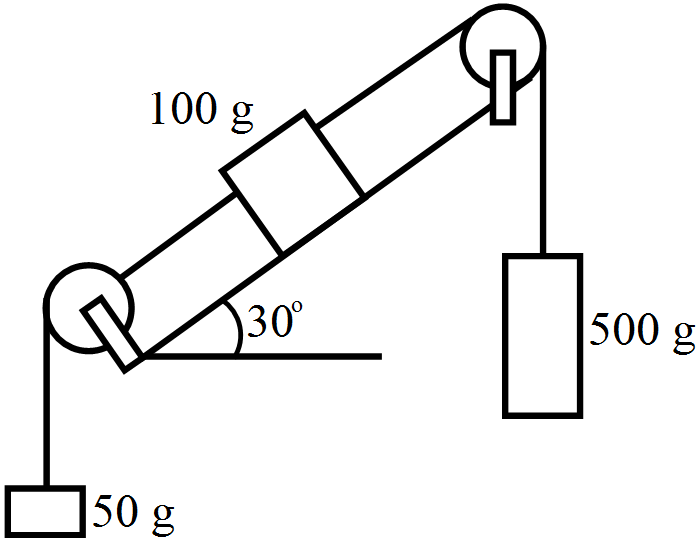
Find the acceleration of the 500g block in figure.

Electrons give up energy at the rate of RI2 per second to the thermal energy. What time scale would one associate with energy in problem (a)? n = no of electron/volume = 1029/m3, length of circuit = 10cm, cross-section = A = (1mm)2.
Consider a uniformly charged ring of radius R. Find the point on the axis where the electric field is maximum.