If $E_{op}^o$ for this electrode is $1.30\,volt$ then what will be the oxidation electrode potential at $pH = 3$ ? .............. $\mathrm{volt}$

- ✓$1.48$
- B$1.20$
- C$1.10$
- D$1.05$
If $E_{op}^o$ for this electrode is $1.30\,volt$ then what will be the oxidation electrode potential at $pH = 3$ ? .............. $\mathrm{volt}$
${{\text{E}}_{op}}=\text{E}_{o\text{p}}^{o}-0.059\,\,{{\log }_{10\,}}\left[ {{\text{H}}^{+}} \right]$
$=\text{E}_{\text{op}}^{o}+0.059\times \text{pH}$
${=1.3+0.059 \times 3}$
${=1.33+0.177}$
${=1.477}$
${=1.48\, \mathrm{Volt}}$
Generate a complete, print-ready paper with questions like this in minutes — across 16+ boards, with answer keys.

$A\xrightarrow{NaN{{O}_{2}}/HCl}B\xrightarrow{KCN}C\xrightarrow{{{H}_{3}}{{O}^{+}}}$ benzoic acid
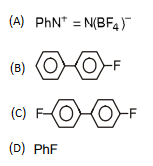
The compound $ A$ is
Statement $(I)$ : A $\pi$ bonding $MO$has lower electron density above and below the inter-nuclear asix.
Statement $(II)$ : The $\pi^*$ antibonding $MO$ has a node between the nucles.In the light of the above statements, choose the most appropriate answer from the options given below: