MCQ
The horizontal range and maximum height attained by a projectile are $R$ and $H$, respectively. If a constant horizontal acceleration $a=g / 4$ is imparted to the projectile due to wind, then its horizontal range and maximum height will be
  • A
    $(R+H), \frac{H}{2}$
  • B
    $\left(R+\frac{H}{2}\right), 2 H$
  • C
    $( R +2 H ), H$
  • $(R+H), H$

Answer

Correct option: D.
$(R+H), H$
d
(d)

$H=H$ (as vertical component of acceleration has not changed)

$R^{\prime} =u_x T+\frac{1}{2} a_x T^2$

$=R+\frac{1}{2} \times \frac{g}{4} \times \frac{4 u^2 \sin ^2 \theta}{g^2}$

$=R \frac{u^2 \sin ^2 \theta}{2 g}=(R+H)$

Need a full question paper?

Generate a complete, print-ready paper with questions like this in minutes — across 16+ boards, with answer keys.

Start Generating Free

Similar questions

If radius of the sphere is $(5.3 \pm 0.1)\;cm$. Then percentage error in its volume will be
Match List $I$ with List $II$

List $I$ List $II$
$A$ Spring constant $I$ $(T ^{-1})$
$B$ Angular speed $II$ $(MT ^{-2})$
$C$ Angular momentum $III$ $(ML ^2)$
$D$ Moment of Inertia $IV$ $(ML ^2 T ^{-1})$

Choose the correct answer from the options given below

A particle executes $S.H.M.$ according to equation $x=10( cm ) \cos \left[2 \pi t+\frac{\pi}{2}\right]$, where $t$ is in second. The magnitude of the velocity of the particle at $t=\frac{1}{6} \,s$ will be .............. $cm / s$
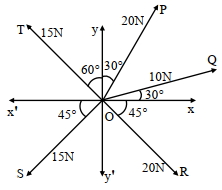
The resultant of these forces $\overrightarrow{O P}, \overrightarrow{O Q}, \overrightarrow{O R}, \overrightarrow{O S}$ and $\overrightarrow{{OT}}$ is approximately $\ldots \ldots {N}$.

[Take $\sqrt{3}=1.7, \sqrt{2}=1.4$ Given $\hat{{i}}$ and $\hat{{j}}$ unit vectors along ${x}, {y}$ axis $]$

A disc is rolling without slipping on a straight surface. The ratio of its translational kinetic energy to its total kinetic energy is
Two stones are thrown up simultaneously with initial speeds of ' $u_1$ and $u_2\left(u_2 > u_1\right)$. They hit the ground after $6\,s$ and $10\,s$ respectively. Which graph in figure correctly represents the time variation of $\Delta x=\left(x_2-x_1\right)$, the relative position of the second stone with respect to the first upto $t=10\,s$ ? Assume that the stones do not rebound after hitting the ground.
A $100\, m$ long train is moving with a uniform velocity of $45\, km/hr$. The time taken by the train to cross a bridge of length $1 \,km$ is.........$s$
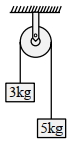
Two blocks of masses $3 \,{kg}$ and $5\, {kg}$ are connected by a metal wire going over a smooth pulley. The breaking stress of the metal is $\frac{24}{\pi} \times 10^{2}\, {Nm}^{-2}$. What is the minimum radius of the wire? (Take $\left.g=10\, {ms}^{-2}\right)$ (in $cm$)
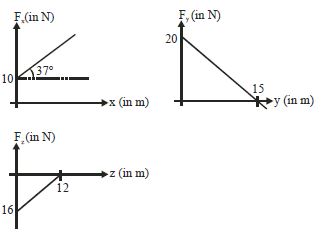
The components of a force acting on a particle are varying according to the graphs shown. To reach at point $B\, (8, 20, 0)$ from point $A\,(0, 5, 12)$ the particle moves on paths parallel to $x-$ axis then $y-$ axis and then $z-$ axis, then work done by this force is ............ $\mathrm{J}$
When a hot liquid is mixed with a cold liquid, the temperature of the mixture:
  1. First decreases then becomes constant.
  2. First increases then becomes constant.
  3. Continuously increases.
  4. Is undefined for some time and then becomes nearly constant.