Question
The human eye has an approximate angular resolution of $\phi=5.8\times10^{-4}$ rad and a typical photoprinter prints a minimum of 300dpi (dots per inch, 1inch = 2.54cm). At what minimal distance z should a printed page be held so that one does not see the individual dots.
Answer

We are given that, angular resolution of human eye $(\phi)=5.8\times10^{-4}$ red.
The printer prints 300 dots per inch.
The linear distance (l) between two dots can be calculated as $\frac{2.54}{300}\text{cm.}$
$=0.84\times10^{-2}\text{cm}$
Now, at a distance of z cm, this subtends an angle, $\phi=\frac{\text{l}}{\text{Z}}$
Substituting $(\phi)=5.8\times10^{-4}\text{ red and }=0.84\times10^{-2}\text{cm}$, we get
$\text{Z}=\frac{0.84\times10^{-2}\text{cm}}{5.8\times10^{-4}}=14.5\text{cm}.$

Need a full question paper?

Generate a complete, print-ready paper with questions like this in minutes — across 16+ boards, with answer keys.

Start Generating Free

Similar questions

The sunlight reaching Earth has maximum electric field of $810Vm^{-1}$. What is the maximum magnetic field in this light?
Explain isotopes, isobars, isotones and isomers by giving examples.
A certain material has refractive indices 1.56, 1.60 and 1.68 for red, yellow and violet light respectively.
  1. Calculate the dispersive power.
  2. Find the angular dispersion produced by a thin prism of angle 6° made of this material.
How many time constants will elapse before the power delivered by a battery drops to half of its maximum value in an RC circuit?
Two particles of masses $m_1$ and $m_2$ are joined by a light rigid rod of length r. The system rotates at an angular speed co about an axis through the centre of mass of the system and perpendicular to the rod. Show that the angular momentum of the system is $\text{L}=\mu\text{r}^2\omega$ where $\mu$ is the reduced mass of the system defined as $\mu=\frac{\text{m}_1\text{m}_2}{\text{m}_1+\text{m}_2}.$
Find the moment of inertia of a uniform square plate of mass m and edge a about one of its diagonals.
In a Young’s double-slit experiment, the slits are separated by 0.28 mm and the screen is placed 1.4 m away. The distance between the central bright fringe and the fourth bright fringe is measured to be 1.2 cm. Determine the wavelength of light used in the experiment.
A man uses a concave mirror for shaving. He keeps his face at a distance of 25cm from the mirror and gets an image which is 1.4 times enlarged. Find the focal length of the mirror.
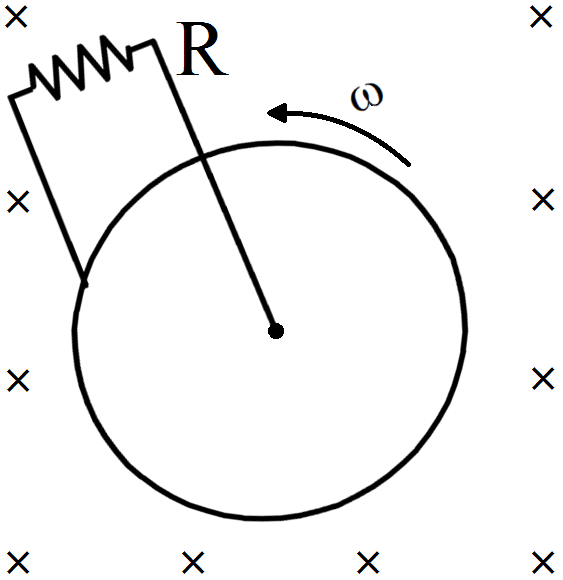
Figure shows a conducting disc rotating about its axis in a perpendicular magnetic field B. A resistor of resistance R is connected between the centre and the rim. Calculate the current in the resistor. Does it enter the disc or leave it at the centre? The radius of the disc is 5.0cm, angular speed $\omega=10 \ \text{rad/s}, \ \text{B}=0.40\text{T}$ and $\text{R}=10\Omega.$
Does a nucleus lose mass when it suffers gamma decay?