Question
The hyper-metropia is a
|
(a) Short-side defect |
(b) Long- side defect |
|
(c) Bad vision due to old age |
(d) None of these |
The hyper-metropia is a
|
(a) Short-side defect |
(b) Long- side defect |
|
(c) Bad vision due to old age |
(d) None of these |
(b) Long- side defect
Generate a complete, print-ready paper with questions like this in minutes — across 16+ boards, with answer keys.
In nuclear fission, the fission reactions proceeds with a projectile. Which of the following suits the best
|
(a) Slow proton |
(b) Fast neutron |
(c) Slow neutron |
(d) None of these |
In the above question, the power lost in the cable during transmission is
|
(a) 12.5 kW |
(b) 6.25 kW |
(c) 25 kW |
(d) 3.15 kW |
Radioactivity was discovered by
|
(a) Becquerel |
(b) Pierre Curie |
(c) Roentgen |
(d) Rutherford |
5 amperes of current is passed through a metallic conductor. The charge flowing in one minute in coulombs will be
|
(a) 5 |
(b) 12 |
(c) 1/12 |
(d) 300 |
The equivalent resistance between the points P and Q in the network given here is equal to (given r =  )
)

|
(a) |
(b) 1 W |
(c) |
(d) 2 W |
A rectangular block of glass ABCD has a refractive index 1.6. A pin is placed midway on the face AB (Fig). When observed from the face AD, the pin shall:
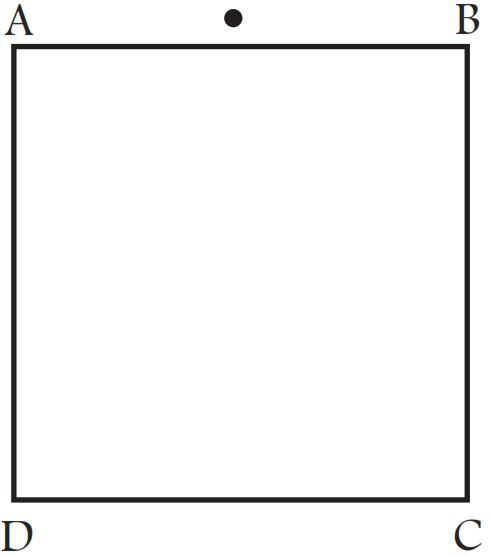
Two equal charges q are placed at a distance of 2a and a third charge -2q is placed at the midpoint. The potential energy of the system is
|
(a) |
(b) |
(c) |
(d) |
Minimum excitation potential of Bohr's first orbit in hydrogen atom is
|
(a) 13.6 V |
(b) 3.4 V |
(c) 10.2 V |
(d) 3.6 V |


