Question
The hyper-metropia is a

Answer

( b)

Need a full question paper?

Generate a complete, print-ready paper with questions like this in minutes — across 16+ boards, with answer keys.
Start Generating Free

Similar questions

A body is moving with velocity $30\; m/s$ towards east. After $10$ seconds its velocity becomes $40\; m/s$ towards north. The average acceleration of the body is ...... $m/s^2$
The speed of light in media $'A'$ and $'B'$ are $2.0 \times$ $10^{10} \,cm / s$ and $1.5 \times 10^{10} \,cm / s$ respectively. A ray of light enters from the medium $B$ to $A$ at an incident angle ' $\theta$ '. If the ray suffers total internal reflection, then
A nucleus disintegrates into two smaller parts, which have their velocities in the ratio $3: 2$. The ratio of their nuclear sizes will be $\left(\frac{x}{3}\right)^{\frac{1}{3}}$. The value of ' $x$ ' is :
The drift velocity of free electrons in a conductor is ‘$v$’ when a current ‘$i$’ is flowing in it. If both the radius and current are doubled, then drift velocity will be
A wind-powered generator converts wind energy into electrical energy. Assume that the generator converts a fixed fraction of the wind energy intercepted by its blades into electrical energy. For wind speed $v$, the electrical power output will be most likely proportional to
In the line spectra of hydrogen atom, difference between the largest and the shortest wavelengths of the Lyman series is $304\,\mathring {A}.$ The corresponding difference for the Paschan series in $\mathring {A}$ is
A 5 cm long solenoid having 10 ohm resistance and 5 mH inductance is joined to a 10 V battery. At steady state, the current through the solenoid (in ampere) will be:
Keeping dissimilar poles of two magnets of equal pole strength and length same side, their time period will be
$A$ horizontal force $F = mg/3$ is applied on the upper surface of a uniform cube of mass $‘m’$ and side $‘a’$ which is resting on a rough horizontal surface having $\mu_S = 1/2$. The distance between lines of action of $‘mg’$ and normal reaction $‘N’$ is :
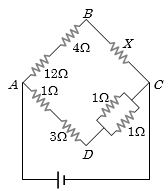
In the circuit shown in the adjoining figure, the current between $B$ and $D$ is zero, the unknown resistance is of ................ $\Omega$