MCQ
The idea of parmanu was given by:
- AMaharishi Kanad
- BDemocritus
- CDalton
- DWilliam Crookes
Explanation:
John Dalton (1766 – 1844), an English chemist and physicist, is the man credited today with the development of atomic theory. However, a theory of atoms was actually formulated 2,500 years before Dalton by an Indian sage and philosopher, known as Acharya Kanad.
Generate a complete, print-ready paper with questions like this in minutes — across 16+ boards, with answer keys.
Weber/m2 is equal to
|
(a) Volt |
(b) Henry |
(c) Tesla |
(d) All of these |
The kinetic energy of an electron revolving around a nucleus will be
| (a) Four times of P.E. | (b) Double of P.E. | (c) Equal to P.E. | (d) Half of its P.E. |
An infinite sequence of resistance is shown in the figure. The resultant resistance between A and B will be, when  and
and 
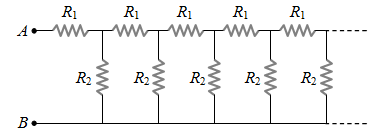
|
(a) Infinity |
(b) 1 Ω |
(c) 2 Ω |
(d) 1.5 Ω |
An isolated solid metallic sphere is given +Q charge. The charge will be distributed on the sphere
|
(a) Uniformly but only on surface |
|
(b) Only on surface but non-uniformly |
|
(c) Uniformly inside the volume |
|
(d) Non-uniformly inside the volume |