MCQ
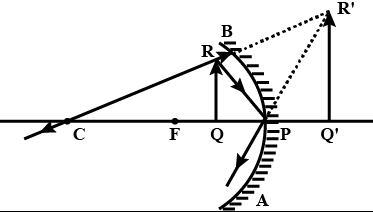
The image formed behind a mirror and a virtual image:
- AAre of same nature
- BAre of different nature
- CAre of same nature only in space
- DAre of different nature only in space
The image formed behind a mirror and a virtual image:
Explanation:
The image formed behind a mirror is virtual in nature. So, they are of the same nature always.
Generate a complete, print-ready paper with questions like this in minutes — across 16+ boards, with answer keys.
If the separation between slits in Young’s double slit experiment is reduced to  the fringe width becomes n times. The value of n is
|
(a) 3 |
(b) |
(c) 9 |
(d) |
Two capacitors of capacitance 2 μF and 3μF are joined in series. Outer plate first capacitor is at 1000 volt and outer plate of second capacitor is earthed (grounded). Now the potential on inner plate of each capacitor will be
|
(a) 700 Volt |
(b) 200 Volt |
(c) 600 Volt |
(d) 400 Volt |
A charge of Q coulomb is placed on a solid piece of metal of irregular shape. The charge will distribute itself
|
(a) Uniformly in the metal object |
|
(b) Uniformly on the surface of the object |
|
(c) Such that the potential energy of the system is minimised |
|
(d) Such that the total heat loss is minimised |
A real image is formed by:
Two metallic charged spheres whose radii are 20 cm and 10 cm respectively, have each 150 micro - coulomb positive charge. The common potential after they are connected by a conducting wire is
|
(a) 9 × |
(b) 4.5 × |
(c) 1.8 × |
(d) 13.5 × |
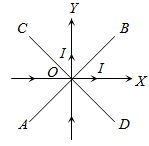
Two very thin metallic wires placed along X and Y-axis carry equal currents as shown here. AB and CD are lines at 45° with the axes with origin of axes at O. The magnetic field will be zero on the line
|
(a) AB |
(b) CD |
|
(c) Segment OB only of line AB |
(d) Segment OC only of line CD |


