Question
The image formed by a concave mirror:
  1. Is always real.
  2. Is always virtual.
  3. Is certainly real if the object is virtual.
  4. Is certainly virtual if the object is real.
Answer

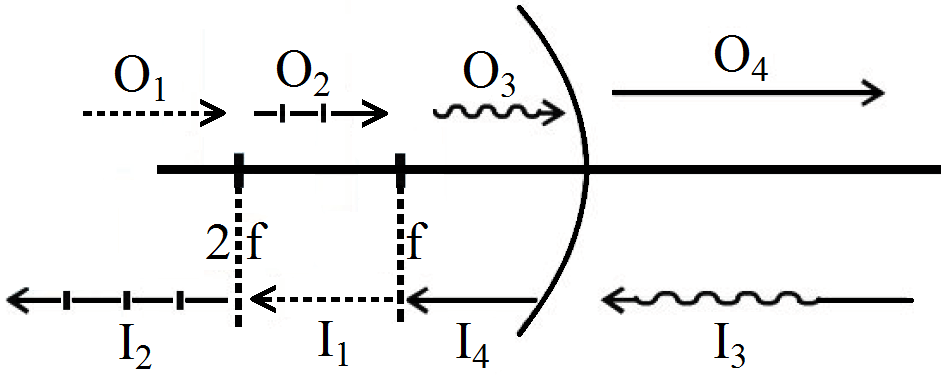
  1. Is certainly real if the object is virtual.

Explanation:

Object
Image
O1
I1
O2
I2
O3
I3
O4
I4

Here O4 is virtual oblect & I4 is real image.

Need a full question paper?

Generate a complete, print-ready paper with questions like this in minutes — across 16+ boards, with answer keys.

Start Generating Free

Similar questions

In an A.C. circuit the potential difference across an inductance and resistance joined in series are respectively 16V and 20V. The total potential difference across the circuit is.
For germanium diode, the junction voltage is about _____.

The process of superimposing signal frequency (i.e. audio wave) on the carrier wave is known as

(a) Transmission

(b) Reception

(c) Modulation

(d) Detection

The minimum temperature of a body at which it emits light is

(a) 1200°C

(b) 1000°C

(c) 500°C

(d) 200°C

Focal length of a convex lens will be maximum for

(a) Blue light

(b) Yellow light

(c) Green light

(d) Red light

Find the true statement.
The magnetic moment of a bar magnet is thus ...A... to the magnetic moment of an equivalent solenoid that produces the same magnetic field.
Here, A refers to.
The distinction between conductors, insulators and semiconductors is largely concerned with:
When the velocity of an electron increases, its de Broglie wavelength:

Assertion   :   Free electron always keep on moving in a conductor even then no magnetic force act on them in magnetic field unless a current is passed through it.

Reason       : The average velocity of free electron is zero.

(a) If both assertion and reason are true and the reason is the correct explanation of the assertion.

(b) If both assertion and reason are true but reason is not the correct explanation of the assertion.

(c) If assertion is true but reason is false.

(d) If the assertion and reason both are false.