MCQ
The incorrect statement is
  • A
    The second ionisation energy of $Se$ is greater than that of second ionisation  energy of $As$
  • B
    The first ionisation energy of $C^{2+}$ ion is greater than that of first ionisation  energy of $N^{2+}$ ­ion
  • C
    The third ionisation energy of, $F$ is greater than that of third ionisation energy of $O$
  • Helogens have highest $I.E.$ in respective period

Answer

Correct option: D.
Helogens have highest $I.E.$ in respective period
d
$(a)\,\mathop {Se}\limits_{4{p^4}} \xrightarrow{{I.E{._1}}}\mathop {S{e^ + }}\limits_{4{p^3}} \xrightarrow{{I.E{._2}}}\mathop {S{e^{2 + }}}\limits_{4{p^2}} $   $\mathop {As}\limits_{4{p^3}} \xrightarrow{{I.E{._1}}}\mathop {A{s^ + }}\limits_{4{p^2}} \xrightarrow{{I.E{._2}}}\mathop {A{s^{2 + }}}\limits_{4{p^1}} $

$(b)\,\mathop C\limits_{2{p^2}}  \to \mathop {{C^ + }}\limits_{2{p^1}}  \to C_{2{s^2}}^{2 + }$   $\mathop N\limits_{2{p^3}}  \to \mathop {{N^ + }}\limits_{2{p^2}}  \to \mathop {{N^{2 + }}}\limits_{2{p^1}} $   $\mathop O\limits_{2{p^4}}  \to \mathop {{O^ + }}\limits_{2{p^3}}  \to \mathop {{O^{2 + }}}\limits_{2{p^2}} $

$(c)\,\mathop F\limits_{2{p^5}} \xrightarrow{{I.E{._1}}}\mathop {{F^ + }}\limits_{2{p^4}} \xrightarrow{{I.E{._2}}}\mathop {{F^{2 + }}}\limits_{2{p^3}} \xrightarrow{{I.E{._3}}}{F^{3 + }}$   $\mathop O\limits_{2{p^4}} \xrightarrow{{I.E{._1}}}\mathop {{O^ + }}\limits_{2{p^3}} \xrightarrow{{I.E{._2}}}\mathop {{O^{2 + }}}\limits_{2{p^2}} \xrightarrow{{I.E{._3}}}{O^{3 + }}$

$(d)$ In respective period, noble gases have highest $I.E.$
Need a full question paper?

Generate a complete, print-ready paper with questions like this in minutes — across 16+ boards, with answer keys.

Start Generating Free

Similar questions

The product formed when toluene is heated in light with $C{l_2}$ and in absence of halogen carrier is
$\text{xKMnO}_4+\text{NH}_3\xrightarrow{ \ \ \ \ \ \ \ \ \ \ }\text{yKNO}_3$
$+\text{MnO}_3+\text{KOH}+\text{H}_2\text{O}$
The volume $(\text { in } \mathrm{mL})$ of $0.125\; \mathrm{M}\; \mathrm{AgNO}_{3}$ required to quantitatively precipitate chloride ions in $0.3\; \mathrm{g}$ of $\left[\mathrm{Co}\left(\mathrm{NH}_{3}\right)_{6}\right] \mathrm{Cl}_{3}$ is $^{\mathrm{M}}\left[\mathrm{Co}\left(\mathrm{NH}_{3}\right)_{6}\right] \mathrm{Cl}_{3}=267.46 \;\mathrm{g} / \mathrm{mol}$ $\mathrm{M}_{\mathrm{AgNO}_{3}}=169.87 \;\mathrm{g} / \mathrm{mol}$
Given below are two statements

Statement $-I :$ Retardation factor $\left( R _{ f }\right)$ can be measured in meter/centimeter.

Statement $-II :$ $R _{ f }$ value of a compound remains constant in all solvents.

Choose the most appropriate answer from the options given below

In which case change in $pH$ is maximum? 
Which of the following is more stable than the remaining three
In which of the following $C-Cl$ bond length is minimum ?
If $P$ to $T$ are second period $p-$ block elements then which of the following  graph show correct relation between valence electrons in $P_2$ to $T_2$  (corresponding molecules) and their bond order is
The energy of an electron in the first Bohr orbit of $H$atom is $ - 13.6\,eV$. The possible energy value $(s)$ of the excited state $(s)$ for electrons in Bohr orbits to hydrogen is(are) ............. $\mathrm{eV}$
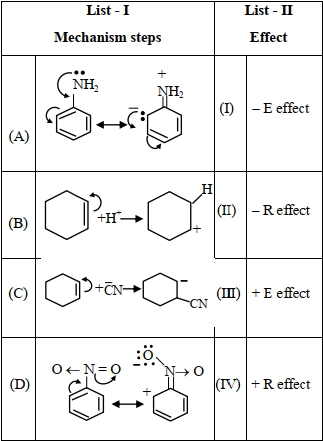
Match List -$I$ with List $II$:

(Image)

Choose the correct answer from the options given below :