MCQ
The incorrect statement regarding molecular orbital $(s)$ is
  • A
    If there is a nodal plane perpendicular to the internuclear axis and lying between  the nuclei of bonded atoms then corresponding orbitals is antibonding $M.O.$
  • B
    If a nodal plane lies in the inter-nuclear axis, then corresponding orbitals is $pi(\pi)$  bonding $M .O.$
  • C
    The $\sigma$ -bonding molecular orbital does not contain nodal planes containing  the ternuclear axis
  • The $\delta$ -bonding molecular orbital possesses three nodal planes containing  the internuclear axis.

Answer

Correct option: D.
The $\delta$ -bonding molecular orbital possesses three nodal planes containing  the internuclear axis.
d
The $\delta$ molecular orbital possesses $2$ nodal planes containing the internuclear axis.

Need a full question paper?

Generate a complete, print-ready paper with questions like this in minutes — across 16+ boards, with answer keys.

Start Generating Free

Similar questions

Which of the following options is correct $w.r.t$ bonds/forces of attraction
Borazine, also known as inorganic benzene, can be prepared by the reaction of $3-equivalents$ of " $X$ " with $6-equivalents$ of "$Y$"."$X$" and "$Y$", respectively are.
Highest entropy is in
Which of the following compounds is not matched correctly with its structure ?
Rank the following in the increasing order of rate of reaction with $HBr$
The electrophile in the nitration of benzene is
The correct statements from the following are :

$(A)$ The decreasing order of atomic radii of group $13$ elements is $\mathrm{Tl}>\mathrm{In}>\mathrm{Ga}>\mathrm{Al}>\mathrm{B}$.

$(B)$ Down the group $13$ electronegativity decreases from top to bottom.

$(C)$ $\mathrm{Al}$ dissolves in dil. $\mathrm{HCl}$ and liberate $\mathrm{H}_2$ but conc. $\mathrm{HNO}_3$ renders Al passive by forming a protective oxide layer on the surface.

$(D)$ All elements of group 13 exhibits highly stable +1 oxidation state.

$(E)$ Hybridisation of $\mathrm{Al}$ in $\left[\mathrm{Al}\left(\mathrm{H}_2 \mathrm{O}\right)_6\right]^{3+}$ ion is $\mathrm{sp}^3 \mathrm{~d}^2$.

Choose the correct answer from the options given below:

During the qualitative analysis of salt with cation $y ^{2+}$, addition of a reagent $( X )$ to alkaline solution of the salt gives a bright red precipitate. The reagent $( X )$ and the cation $\left( y ^{2+}\right)$ present respectively are .... .
The orbital with maximum energy is
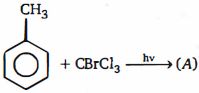
(no ring substitution) Product $(A)$ is