Question
The instantaneous voltage from an ac source is given by $\text{E}=300\sin314\text{t};$ what is the rms voltage of the source.

Answer

Given equation is E $=300\sin314\text{t}$
Comparing with standard equation $\text{E = E}_0\sin\omega\text{t},$ we have
$\text{E}_0=300\text{volt}$
So, $\text{E}_{\text{rms}}=\frac{\text{E}_0}{\sqrt{2}}=\frac{300}{\sqrt{2}}=150\sqrt{2}\text{volt}$
$=150\times1.414=212\text{V}$

Need a full question paper?

Generate a complete, print-ready paper with questions like this in minutes — across 16+ boards, with answer keys.
Start Generating Free

Similar questions

  1. Find the first excitation potential of He+ ion.
  2. Find the ionization potential of Li++ ion.
Two 120V light bulbs, one of 25W and the other of 200W were connected in series across a 240V line. One bulb burnt out almost instantaneously. Which one was burnt and why?
Two trains are travelling towards each other both at a speed of 90km/h. If one of the trains sounds a whistle at 500Hz, what will be the apparent frequency heard in the other train? Speed of sound in air = 350m/s.
Draw a diagram to show the standing pressure wave and standing displacement wave for the 3rd overtone mode of vibration of an open organ pipe.
Give the mass number and atomic number of elements on the right hand side of the decay process.
$^{220}_{86}\text{Ru}\ \ \rightarrow\ \ \text{Po}\ \ +\ \ \text{He}$
Define current sensitivity and voltage sensitivity of a galvanometer.
Increasing the current sensitivity may not necessarily increase the voltage sensitivity of a galvanometer. Justify.
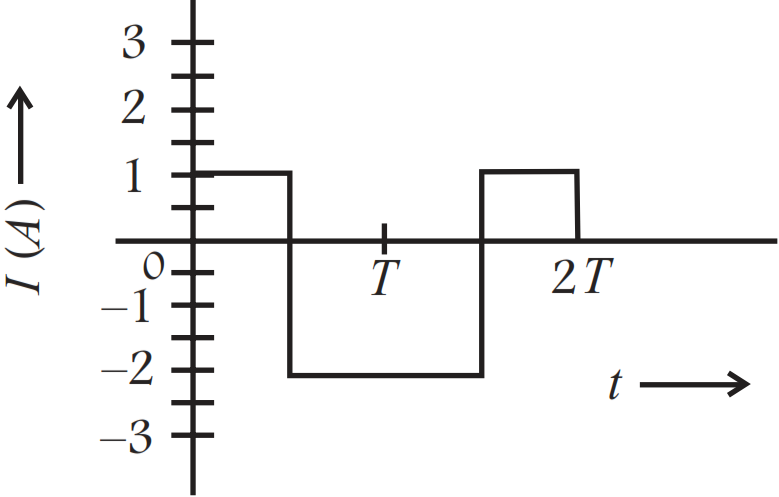
The alternating current in a circuit is described by the graph shown in Fig. Show rms current in this graph.

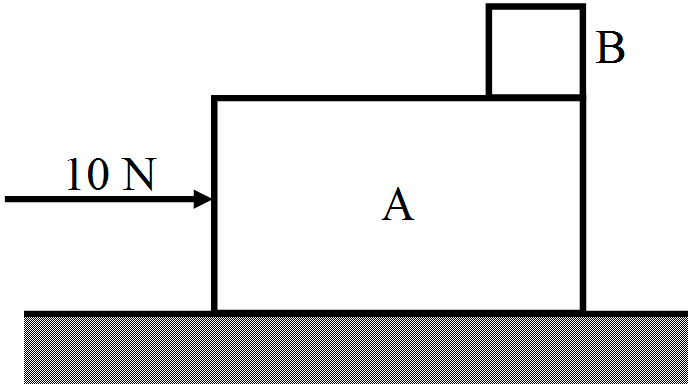
A small block B is placed on another block A of mass 5kg and length 20cm. Initially the block B is near the right end of block A. A constant horizontal force of 10N is applied to the block A. All the surfaces are assumed frictionless. Find the time elapsed before the block B separates from A.

The wavelength of $\text{K}_\alpha$ X-ray of tungsten is 21.3pm. It takes 11.3keV to knock out an electron from the L shell of a tungsten atom. What should be the minimum accelerating voltage across an X-ray tube having tungsten target which allows production of $\text{K}_\alpha$ X-ray?
Explain the first law of reflection of light.