MCQ
The integral $\int_{\frac{\pi }{{12}}}^{\frac{\pi }{4}} {\frac{{8\,\cos \,2x}}{{{{\left( {\tan \,x + \cot \,x} \right)}^3}}}\,dx} $ equals
  • $\frac{{15}}{{128}}$
  • B
    $\frac{{15}}{{64}}$
  • C
    $\frac{{13}}{{32}}$
  • D
    $\frac{{15}}{{256}}$

Answer

Correct option: A.
$\frac{{15}}{{128}}$
a
$\int\limits_{\frac{\pi }{{12}}}^{\frac{\pi }{4}} {\frac{{\cos 2x}}{{{{\left( {\frac{1}{{\sin 2x}}} \right)}^3}}} = } \int\limits_{\frac{\pi }{{12}}}^{\frac{\pi }{4}} {\cos 2x}  \times \sin 2x \cdot {\sin ^2}(2x)dx$

$ = \frac{1}{4}\int\limits_{\frac{\pi }{{12}}}^{\frac{\pi }{4}} {\sin 4x.\left( {1 - \cos 4x} \right)} dx$

$ = \frac{1}{4}\left[ {\int\limits_{\frac{\pi }{{12}}}^{\frac{\pi }{4}} {\sin 4x}  - \frac{1}{2}\int\limits_{\frac{\pi }{{12}}}^{\frac{\pi }{4}} {\sin 8x} } \right]$

$ = \frac{1}{4}\left[ {\frac{{\cos 4x}}{4} + \frac{{\cos 8x}}{{16}}} \right]_{\pi /12}^{\pi /4} - \frac{1}{4}\left[ {\frac{{15}}{{23}}} \right]$

$ = \frac{{15}}{{128}}$

Need a full question paper?

Generate a complete, print-ready paper with questions like this in minutes — across 16+ boards, with answer keys.

Start Generating Free

Similar questions

The coefficient of the term independent of $x$ in the expansion of $(1 + x + 2x^3)$ ${\left( {\frac{3}{2}{x^2} - \frac{1}{{3x}}} \right)^9}$ is
For $x \in(-1,1]$, the number of solutions of the equation $\sin ^{-1} x=2 \tan ^{-1} x$ is equal to
The lines $\mathrm{L}_1, \mathrm{~L}_2, \ldots, \mathrm{L}_{20}$ are distinct. For $\mathrm{n}=1,2,3, \ldots, 10$ all the lines $\mathrm{L}_{2 \mathrm{n}-1}$ are parallel to each other and all the lines $L_{2 n}$ pass through a given point $P$. The maximum number of points of intersection of pairs of lines from the set $\left\{\mathrm{L}_1, \mathrm{~L}_2, \ldots, \mathrm{L}_{20}\right\}$ is equal to :
If $u = {({x^2} + {y^2} + {z^2})^{3/2}}$, then ${\left( {{{\partial u} \over {\partial x}}} \right)^2} + {\left( {{{\partial u} \over {\partial y}}} \right)^2} + {\left( {{{\partial u} \over {\partial z}}} \right)^2} = $
Let $A =\left\{ z \in C :\left|\frac{ z +1}{ z -1}<1\right|\right\}$ and $B =\left\{ z \in C : \arg \left(\frac{ z -1}{ z +1}\right)=\frac{2 \pi}{3}\right\}$ Then $A \cap B$ is
Let $\frac{1}{{{x_1}}},\frac{1}{{{x_2}}},\frac{1}{{{x_3}}},.....,$  $({x_i} \ne \,0\,for\,\,i\, = 1,2,....,n)$  be in $A.P.$  such that  $x_1 = 4$ and $x_{21} = 20.$ If $n$  is the least positive integer for which $x_n > 50,$  then $\sum\limits_{i = 1}^n {\left( {\frac{1}{{{x_i}}}} \right)} $  is equal to.
A stick of length l rests against the floor and a wall of a room. If the stick begins to slide on the floor, then the locus of its middle point is
If $f(x)=\int_{0}^{x}(5+|1-t|) d t, \quad x>2$

$\quad \quad \quad \quad \quad 5 x+1,\quad \quad \quad \quad \quad x \leq 2$, then
If $z + {z^{ - 1}} = 1,\,{\rm{then }}\,{z^{100}} + {z^{ - 100}}$ is equal to
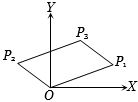
If the points ${P_1}$and ${P_2}$ represent two complex numbers ${z_1}$ and ${z_2}$, then the point ${P_3}$ represents the number