MCQ
The interval on which the function f(x) = 2x3 + 9x2 + 12x - 1 is decreasing is:
  • A
    $[-1,\infty)$
  • B
    $[-2,-1]$
  • C
    $(-\infty ,-2]$
  • D
    $[-1,1]$

Answer

  1.  $[-2,-1]$

Solution:

We have, f(x) = 2x3 + 9x2 + 12x - 1

$\therefore$ f'(x) = 6x2 + 18x + 12

= 6(x2 + 3x + 2) = 6(x + 2)(x + 1)

So, $\text{f}'(\text{x})\leq0,$ for decreasing.

On drawing number lines as below.
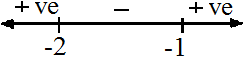
We see that f'(x) is decreasing in [-2, -1].

Need a full question paper?

Generate a complete, print-ready paper with questions like this in minutes — across 16+ boards, with answer keys.

Start Generating Free

Similar questions

If $\begin{vmatrix}\text{a}&\text{p}&\text{x}\\\text{b}&\text{q}&\text{y}\\\text{c}&\text{r}&\text{z}\end{vmatrix}=16,$ then the value of $\begin{vmatrix}\text{p}+\text{x}&\text{a}+\text{x}&\text{a}+\text{p}\\\text{q}+\text{y}&\text{b}+\text{y}&\text{b}+\text{q}\\\text{r}+\text{z}&\text{c}+\text{z}&\text{c}+\text{r}\end{vmatrix}$ is:
  1. 4
  2. 8
  3. 16
  4. 32
The domain of the function $\text{f(x)}=\frac{1}{\sqrt{\{\sin\text{x}\}+\{\sin(\pi+\text{x})}\}}$ where {.} denotes fractional part, is:
  1. $[0,\pi]$
  2. $(2\text{n}+1)\frac{\pi}{2},\text{n }\in\text{ z}$
  3. $(0,\pi)$
  4. None of these.
The distance of the plane through the intersection of the planes ax + by + cz +d = 0 and lx + my + nz + P = 0 and parallel to the line y = 0, z = 0
$\int_0^\pi {\frac{{dx}}{{1 + \sin x}}} = $
If a curve the $y = f(x)$  passes through point $(1, -1)$ and  satisfies the differential equation $y\left( {1 + xy} \right)dx = xdy$ then $f\left( { - \frac{1}{2}} \right) = $ . . . . . 
If $a\, -\, 2b + c = 1$ , then value of $\left| {\begin{array}{*{20}{c}}
  {x + 1}&{x + 2}&{x + a} \\ 
  {x + 2}&{x + 3}&{x + b} \\ 
  {x + 3}&{x + 4}&{x + c} 
\end{array}} \right|$ is
The number of continuous functions $f:[0,1] \rightarrow R$ that satisfy $\int \limits_0^1 x f(x) d x=\frac{1}{3}+\frac{1}{4} \int \limits_0^1(f(x))^2 d x$ is
If $g(x) = \int_0^x {{{\cos }^4}t\,dt,} $ then $g(x + \pi )$ equals
A random variable has the following probability distribution:

X = xi 0 1 2 3 4 5 6 7
P(X = Xi) 0 2p 2p 3p p2 2p2 7p2 2p
  1. $\frac{1}{10}$

  2. $-1$

  3. $-\frac{1}{10}$

  4. $\frac{1}{5}$

Let × be a binary operation on set Q of rational numbers defined as $\text{a}\times\text{b}=\frac{\text{ab}}{5}.$ Write the identity for ×.
  1. 5
  2. 3
  3. 1
  4. 6