- Apenta ammine nitrito$-N-$cobalt$(II)$ chloride
- ✓penta ammine nitrito$-N-$cobalt$(III)$ chloride
- Cnitrito$-N-$penta ammine cobalt$(III)$ chloride
- Dnitrito$-N-$penta ammine cobalt$(II)$ chloride
(b) If cation is complex, then we first name ligand in alphabetical order and then central atom with oxidation state remain numeral in common brackets.
$\left[\mathrm{Cr}(\mathrm{en})_{2} \mathrm{Br}_{2}\right] \mathrm{Br}-$ is named as dibromidobis (ethylenediamine) chromium(III) bromide:
Ligands are : Br (two), ethyenediammine (two).
Central ion: $\mathrm{Cr}(\mathrm{III})$ or $\mathrm{Cr}^{3+}$
Counter ion: $\mathrm{Br}^{-}$
Generate a complete, print-ready paper with questions like this in minutes — across 16+ boards, with answer keys.


$(A)$ Albumin is a simple protein
$(B)$ The amino acid alanine contains an acidic side chain
$(C)$ Insulin is a hormone
$(D)$ Muscles contain the protein keratin
Point out the wrong statements in the above set of statements
Product in above reaction is
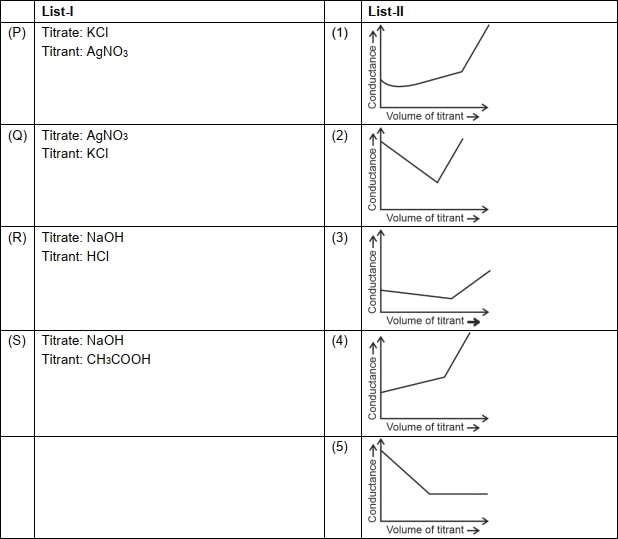
The limiting ionic conductivity ( $\Lambda 0$ ) values (in $mS m ^2 mol ^{-1}$ ) for different ions in aqueous solutions are given below:
| Ions | $Ag ^{+}$ | $K ^{+}$ | $Na ^{+}$ | $H ^{+}$ | $NO _3^{-}$ | $CI ^{-}$ | $SO _4^{2-}$ | $OH ^{-}$ | $CH_3COO ^{-}$ |
| $\Lambda_0$ | $6.2$ | $7.4$ | $5.0$ | $35.0$ | $7.2$ | $7.6$ | $16.0$ | $19.9$ | $4.1$ |
For different combinations of titrates and titrants given in $List-l$, the graphs of 'conductance' versus 'volume of titrant' are given in $List-II$.
Match each entry in $List-I$ with the appropriate entry in $List-II$ and choose the correct option.