MCQ
The IUPAC name for the compound is:
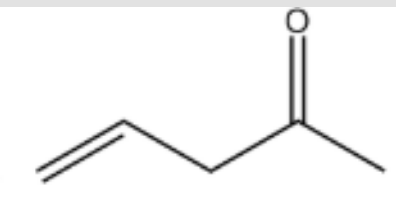
- A2-acetyl prop-1-ene
- Bpent-1-en-4-one
- CPent-4-en-2-one
- Dformyl propene
Explanation:
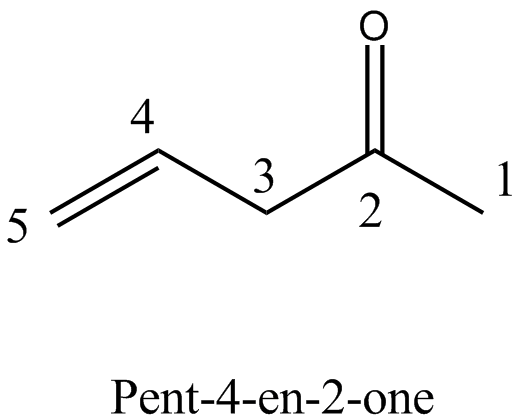
The IUPAC name for the given compound is Pent-4-en-2-one.
The parent hydrocarbon contains 5 C atoms. Hence, the compound is a derivative of pentane. A C=O group is present at second C atom.
Hence the last alphabate 'e' of pentane is replaced with 2-one to obtain pentan-2-one.
There is one C=C double bond between fourth and fifth carbon atom. Hence -an- in pentan-2-one is replaced with 4-en.
Hence, the correct IUPAC name is Pent-4-en-2-one.
Generate a complete, print-ready paper with questions like this in minutes — across 16+ boards, with answer keys.
$C{{H}_{3}}-C\equiv CH\xrightarrow[{{H}_{2}}S{{O}_{4}}]{HgS{{O}_{4}}}A\xrightarrow{NaB{{H}_{4}}}B$
$\left\{ en = H _2 NCH _2 CH _2 NH _2\right.$; atomic numbers: $\left.Ti =22 ; Cr =24 ; Cp =27 ; Pt =78\right\}$
| List-$I$ | List-$II$ |
| $P.$ $\left[ Cr \left( NH _3\right)_4 Cl _2\right) Cl ]$ | $1.$ Paramagnetic and exhibits ionisation isomerism |
| $Q.$ $\left[ Ti \left( H _2 O \right)_5 Cl \right]\left( NO _3\right)_2$ | $2.$ Diamagentic and exhibits cis-trans isomerism |
| $R.$ $\left[ Pt ( en )\left( NH _3\right) Cl \right] NO _3$ | $3.$ Paramagentic and exhibits cis-trans isomerism |
| $S.$ $\left[ Co \left( NH _3\right)_4\left( NO _3\right)_2\right] NO _3$ | $4.$ Diamagentic and exhibits ionisation isomerism |
Codes: $ \quad P \quad Q \quad R \quad S $