MCQ
The $IUPAC$ name of $\beta -$ ethoxy $-\alpha -$ hydroxy propionic acid (trivial name) is :
- A$1,2-$dihydroxy$-1-$oxo$-3-$ethoxy propane
- B$1-$carboxy$-2-$ethoxy ethanol
- ✓$3-$Ethoxy$-2-$hydroxy propanoic acid
- DAll above
The parent compound is propanoic acid. A hydroxy group is present at second carbon atom and an ethoxy group is present at third carbon atom.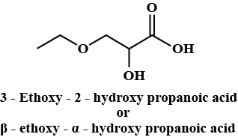
Generate a complete, print-ready paper with questions like this in minutes — across 16+ boards, with answer keys.
$(A)$ $\Lambda \stackrel{0}{ m }$ for electrolyte $A$ is obtained by extrapolation
$(B)$ For electrolyte B, vx $\Lambda m$ vs $\sqrt{ c }$ graph is a straight line with intercept equal to $\Lambda \stackrel{0}{ m }$
$(C)$ At infinite dilution, the value of degree of dissociation approach zero for electrolyte $B$.
$(D)$ $\Lambda \stackrel{0}{ m }$ for any electrolyte $A$ or $B$ can be calculated using $\lambda^{\circ}$ for individual ions.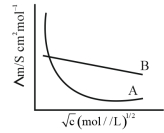
[Given : molar mass of $Br _2=160\,g\,mol ^{-1}$
atomic mass of $C =12\,g\,mol ^{-1}$
atomic mass of $Cl =35.5\,g\,mol ^{-1}$
density of dibromine $=3.2\,g\,cm ^{-3}$
density of $\left.CCl _4=1.6\,g\,cm ^{-3}\right]$