MCQ
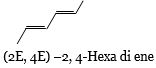
The $IUPAC$ name of compound is
  • A
    $(2Z, 4Z) -2, 4-$hexa di-ene
  • B
    $(2Z, 4E)-2, 4$ hexa di ene
  • C
    $(4Z, 4Z)-2, 4$ hexa di ene
  • $(2E, 4E)-2, 4$ hexa di ene

Answer

Correct option: D.
$(2E, 4E)-2, 4$ hexa di ene
d
(d) If atom or group of higher priority are on opposite direction at the double bond of each carbon atom then the configuration is known as $E$ and if they are in same direction then the configuration is known as $Z$ configuration.

Need a full question paper?

Generate a complete, print-ready paper with questions like this in minutes — across 16+ boards, with answer keys.

Start Generating Free

Similar questions

Select the correct statements of the following :- 

$(a)$ Effective nuclear charge for nitrogen is $3.90$

$(b)$ $IP$ of $Ne$ is more than $Na^+$

$(c)$ Order of electron negativity $sp > sp^2 > sp^3$

$(d)$ Order of acidic character $NH_3 < PH_3 < AsH_3$
Solubility product of a salt $AB $ is $1 \times {10^{ - 8}}$ in a solution in which concentration of $A$ is ${10^{ - 3}}\,M$. The salt will precipitate when the concentration of $B$  becomes more than
Solubility of calcium phosphate (molecular mass, M) in water is Wg per 100mL at 25°C. Its solubility product at 25°C will be approximately.
Which are the correct IUPAC names of the following compound?
$\text{H}_3\text{C}-\text{CH}_2-\text{CH}_2-\text{CH}_2-\text{CH}-\text{CH}_2-\text{CH}_2-\text{CH}_2-\text{CH}_2-\text{CH}_3\\ \ \ \ \ \ \ \ \ \ \ \ \ \ \ \ \ \ \ \ \ \ \ \ \ \ \ \ \ \ \ \ \ \ \ \ \ \ \ \ \ \ \ \ \ \ \ \ \ \ \ \ \ \ |\\ \ \ \ \ \ \ \ \ \ \ \ \ \ \ \ \ \ \ \ \ \ \ \ \ \ \ \ \ \ \ \ \ \ \ \ \ \ \ \ \ \ \ \ \ \ \ \ \ \ \ \ \ \text{CH}_2\\ \ \ \ \ \ \ \ \ \ \ \ \ \ \ \ \ \ \ \ \ \ \ \ \ \ \ \ \ \ \ \ \ \ \ \ \ \ \ \ \ \ \ \ \ \ \ \ \ \ \ \ \ \ |\\ \ \ \ \ \ \ \ \ \ \ \ \ \ \ \ \ \ \ \ \ \ \ \ \ \ \ \ \ \ \ \ \ \ \ \ \ \ \ \ \text{HC}_3-\text{C}-\text{CH}_3\\\ \ \ \ \ \ \ \ \ \ \ \ \ \ \ \ \ \ \ \ \ \ \ \ \ \ \ \ \ \ \ \ \ \ \ \ \ \ \ \ \ \ \ \ \ \ \ \ \ \ \ \ \ |\\ \ \ \ \ \ \ \ \ \ \ \ \ \ \ \ \ \ \ \ \ \ \ \ \ \ \ \ \ \ \ \ \ \ \ \ \ \ \ \ \ \ \ \ \ \ \ \ \ \ \ \ \ \text{CH}_3$
Which is correctly matched ?
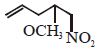
has correct $IUPAC$ name
Number of compounds from the following with zero dipole moment is . . . . . .

$\mathrm{HF}, \mathrm{H}_2, \mathrm{H}_2 \mathrm{~S}, \mathrm{CO}_2, \mathrm{NH}_3, \mathrm{BF}_3, \mathrm{CH}_4, \mathrm{CHCl}_3, \mathrm{SiF}_4$, $\mathrm{H}_2 \mathrm{O}, \mathrm{BeF}_2$

Among the following ions, the $\text{p}\pi−\text{d}\pi$ overlap could be present in:
How many moles of $BH_3$ are needed to react completely with $2\, mole$ of  $1$-pentene in hydroboration-oxidation reaction ?
Actual number of atoms of different elements present in a molecule of a compound is given by