MCQ
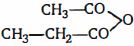
The $IUPAC$ name of  (figure) is
  • Ethanoic propanoic anhydride
  • B
    Propanoic ethanoic anhydride
  • C
    $1-$ Ethanoyloxypropanone
  • D
    $3-$ Ethanoyloxypropan $-3-$ one

Answer

Correct option: A.
Ethanoic propanoic anhydride
a
This anhydride is formed from ethanoic acid and propanoic acid. So name will be: Ethanoic propanoic anhydride.

Need a full question paper?

Generate a complete, print-ready paper with questions like this in minutes — across 16+ boards, with answer keys.

Start Generating Free

Similar questions

The Birch reduction of benzoic acid gives
Which one of the following reducing agents is likely to be the most effective in bringing about the following change

$R - \mathop {\mathop {C\,N{H_2} \to RC{H_2}N{H_2}}\limits^{||\,\,\,\,\,\,\,\,\,\,\,\,\,\,\,\,\,\,\,\,\,\,\,\,\,\,\,\,\,\,\,\,\,\,\,\,\,\,\,\,\,\,\,\,\,\,\,\,\,\,\,} }\limits^{O\,\,\,\,\,\,\,\,\,\,\,\,\,\,\,\,\,\,\,\,\,\,\,\,\,\,\,\,\,\,\,\,\,\,\,\,\,\,\,\,\,\,\,\,\,\,\,\,\,} $

$IUPAC$ name of $C{H_3}CH(OH)C{H_2}C{H_2}COOH$ is
First and second excitation potentials of hydrogen atom (in $eV$) would be respectively
The correct order of bond angles (smallest first) in ${H_2}S,N{H_3},B{F_3}$ and $Si{H_4}$ is
If the light waves pass through a nicol prism then all the oscillations occur only in one plane, such beam of light is called as
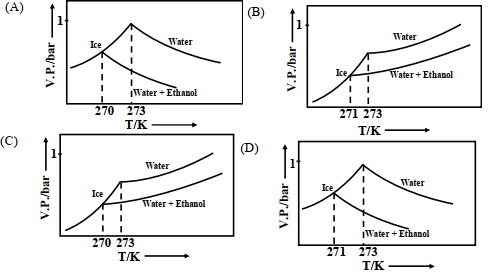
Pure water freezes at $273 \mathrm{~K}$ and $1$ bar. The addition of $34.5 \mathrm{~g}$ of ethanol to $500 \mathrm{~g}$ of water changes the freezing point of the solution. Use the freezing point depression constant of water as $2 \mathrm{~K} \mathrm{~kg} \mathrm{~mol}^{-1}$. The figures shown below represent plots of vapour pressure ($V.P$.) versus temperature ($T$). [molecular weight of ethanol is $46 \mathrm{~g} \mathrm{~mol}^{-1}$ ]

Among the following, the option representing change the freezing point is

(IMAGE)

At constant $T$ and $P$, which one of the following statements is correct for the reaction, $CO(g) + \frac{1}{2}{O_2}(g) \to C{O_2}(g)$
Phenol is
Which of the following molecules are chiral ?