MCQ
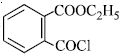
The $IUPAC$ name of given compound is :
  • A
    $2-$ chlorocarbonyl ethylbenzoate
  • B
    $2-$ carboxyethyl benzoyl chloride
  • ethyl $-2-$ (chlorocarbonyl) benzoate
  • D
    ethyl $-1-$ (chlorocarbonyl) benzoate

Answer

Correct option: C.
ethyl $-2-$ (chlorocarbonyl) benzoate
c
Principle functional group is an ester.

IUPAC name:- ethyl - $2$ - (chlorocarbonyl)benzoate

Need a full question paper?

Generate a complete, print-ready paper with questions like this in minutes — across 16+ boards, with answer keys.

Start Generating Free

Similar questions

The $IUPAC$ name of $\begin{array}{*{20}{c}}
  {C{H_3} - CH - CHO\,\,} \\ 
  {|\,\,\,\,\,\,\,\,} \\ 
  {\,\,\,\,\,\,\,\,\,\,\,\,\,\,\,\,\,C{H_2} - C{H_3}} 
\end{array}$ is
A gas decolourised $KMn{O_4}$ solution but gives no precipitate with ammoniacal cuprous chloride is or Which of the following gases does not give a precipitate with ammoniacal solution of silver nitrate but decolourizes $KMn{O_4}$ (neutral or slightly alkaline)
Which electronic level would allow the hydrogen atom to absorb a photon but not to emit a photon
The quantum numbers $+ 1/2$ and $-1/2$ for the electron spin represent
Which compound is a possible product from addition of $Br_2$ to $1$ -butene ?
Which of the following relations are correct?

$(A)$ $\Delta U = q + p \Delta V$

$(B)$ $\Delta G =\Delta H - T \Delta S$

$(C)$ $\Delta S =\frac{ q _{ rev }}{ T }$

$(D)$ $\Delta H =\Delta U -\Delta nRT$

Choose the most appropriate answer from the options given below :

Which of the following will produce chiral molecule after treatment with $H_2$/Lindlar's catalyst ?
Consider the following reaction at $298 \mathrm{~K}$.

$\frac{3}{2} \mathrm{O}_{2(\mathrm{~g})} \rightleftharpoons \mathrm{O}_{3(\mathrm{~g})} \cdot \mathrm{K}_{\mathrm{P}}=2.47 \times 10^{-29} \text {. }$

$\Delta_{\mathrm{r}} \mathrm{G}^{\ominus}$ for the reaction is_______ $kJ$. (Given R $\left.=8.314 \mathrm{JK}^{-1} \mathrm{~mol}^{-1}\right)$

$\Delta {G^o}(HI,\,g) \cong + 1.7\,kJ$. What is the equilibrium constant at ${25\,^o}C$ for $2HI_{(g)} \leftrightharpoons {H_2}_{(g)} + {I_2}_{(g)}$
Which of the following will be octahedral