MCQ
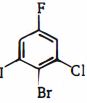
The $IUPAC$ name of  is
  • A
    $1-$ Bromo $-2-$ chloro $-3-$ fluoro $-6-$ iodo benzene
  • $2-$ Bromo $-1-$ chloro $-5-$ fluoro $-3-$ iodo benzene
  • C
    $4-$ Bromo $-2-$ chloro $-5-$ iodo $-1-$ fluoro benzene
  • D
    $2-$ Bromo $-3-$ chloro $- 1-$ iodo $-5-$ fluoro benzene

Answer

Correct option: B.
$2-$ Bromo $-1-$ chloro $-5-$ fluoro $-3-$ iodo benzene
b
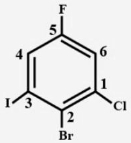
Numbering is according to lowest set of locant rule. Do numbering of substituent alphabetically.

$\therefore$ IUPAC name $=2$-bromo-$1$-chloro-$5$-fluoro-$3$-iodobenzene.

Need a full question paper?

Generate a complete, print-ready paper with questions like this in minutes — across 16+ boards, with answer keys.

Start Generating Free

Similar questions

The correct option with respect to the Pauling electronegativity values of the elements is
$25\ cm^3$ of oxalic acid completely neutrelised $0.064g$ of $\ce{NaOH}$. Molarity of oxalic acid solution is :
A weak acid, $HA,$ has a $K_a$ of $1.00 \times 10^{-5}.$ If $0.100 \,mol$ of this acid is dissolved in one litreof water, the percentage of acid dissociated at equilibrium is closest to.....$\%$
$\ce{pH}$ of water is $7$ at $25^\circ C$. If water is heated at $80^\circ C,$ its $\ce{pH}$ will :
Choose the sequence of steps that describes the best synthesis of $1-$ butene from ethanol
The formation of $N{O_2}$ in the reaction $2NO + {O_2}$ $\rightleftharpoons$ $2N{O_2}$ + heat is favoured by
Given that $K_w$ for water is $10^{-13}\,M^2$ at $62\,^oC$ , compute the sum of $pOH$ and $pH$ for a neutral aqueous solution at $62\,^oC$
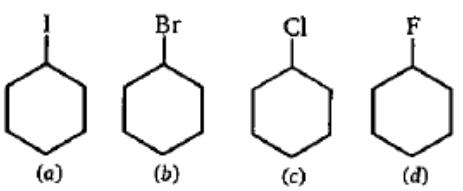
identify the rate of reaction of given compounds in $E_2$​ reaction :
The correct structure of $4-$ bromo $-3-$ methylbut $-1-$ ene is
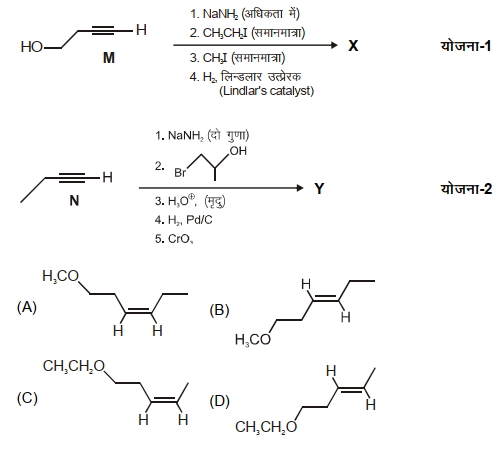
Schemes $1$ and $2$ describe sequential transformation of alkynes $M$ and $N$. Consider only the major products formed in each step for both the schemes. $Image$

$1.$ The product $X$ is

mcq $Image$

$2.$ The correct statement with respect to product $Y$ is :

$(A)$ It gives a positive Tollens test and is a functional isomer of $X$.

$(B)$ It gives a positive Tollens test and is a geometrical isomer of $X$.

$(C)$ It gives a positive iodoform test and is a functional isomer of $X$.

$(D)$ It gives a positive iodoform test and is a geometrical isomer of $X$.

Give the answer question $1$ and $2.$